


Marketplace Management for Ecommerce Brands in Southeast Asia: A Practical Guide (2026)
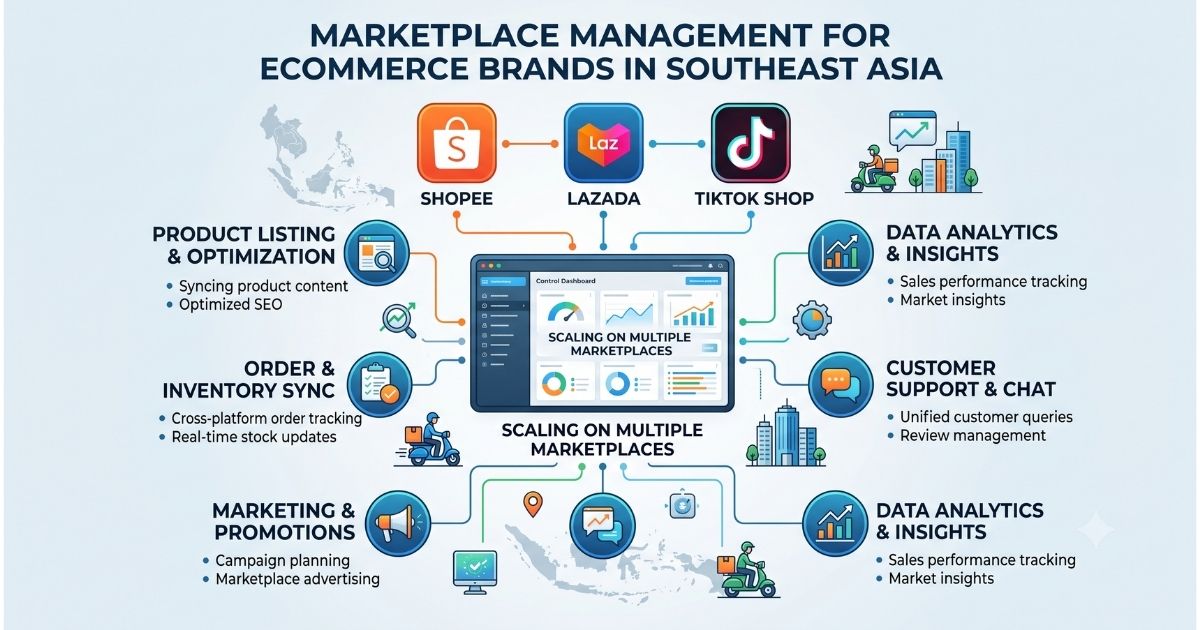
Table of Contents
Running a single marketplace account well takes more operational effort than most brands expect before they do it. Running four — across two or more markets, each with its own promotional calendar, performance scoring system, and content requirements — takes an entirely different kind of infrastructure.
This is not an exaggeration specific to Asia. It is the operating reality that most brands discover only after their first marketplace launch, when the gap between a listings-live account and a high-performing one becomes difficult to close without dedicated resource.
Marketplace management is the operational discipline that bridges that gap. For brands with serious ambitions in Southeast Asia — where Shopee, Lazada, and TikTok Shop compete for the same buyers across the same markets with different mechanics, different algorithms, and different promotional windows — it is one of the most consequential decisions a brand makes: manage in-house and accept the resourcing cost, or work with a partner that already has the expertise, the tools, and the platform relationships in place.
This guide covers what marketplace management actually involves in Southeast Asian ecommerce, why the region’s marketplace landscape makes it harder than most brands plan for, and how to assess whether your current setup is delivering the performance it should.
What Is Marketplace Management?
Marketplace management is the ongoing operation of a brand’s seller accounts across one or more ecommerce platforms — covering product listings, inventory synchronisation, promotional campaigns, customer communications, and performance monitoring. For brands selling across multiple Asian marketplaces simultaneously, it is the operational layer that determines whether platform presence converts to sustained, scalable revenue.
The distinction between having a marketplace account and actively managing one is significant. An account that was set up twelve months ago, with listings that were written at launch and promotions that are running on autopilot, is not being managed — it is being maintained at minimum cost. The gap between maintenance and active management shows up directly in search ranking, conversion rate, and seller rating.
In-House vs. Managed Marketplace Operations
The two broad approaches to marketplace management are operating an internal team dedicated to platform accounts, or working with an external managed service — a marketplace management agency or commerce enablement partner — that operates accounts on the brand’s behalf.
In-house management gives the brand direct control and the ability to act on information without an intermediary. The constraint is resourcing: effective marketplace management across multiple platforms and markets requires platform-specific expertise, tools, and available hours that most brand teams do not have in depth.
Managed marketplace services provide specialist expertise and operational capacity without the fixed cost of building a dedicated internal team. The trade-off is a layer of coordination and, in some models, a lag between brand decisions and execution. The right choice depends on the brand’s internal capabilities, the number of platforms and markets in scope, and the complexity of the product and promotional strategy.
What Marketplace Management Actually Involves
The operational scope of marketplace management is broader than most brands realise before they begin. The visible parts — listing creation and promotions — sit on top of a foundation of operational work that is less visible but equally important.
Account Setup and Ongoing Compliance
Every marketplace account begins with a setup process: business verification, brand registration (increasingly important for anti-counterfeiting protections on Shopee and Lazada), store design, and category approval for regulated product types. This is not a one-time task. Platforms update their verification requirements, category rules, and brand registration processes regularly — and accounts that fall out of compliance can face listing suppression or account suspension without warning.
Staying compliant also means tracking changes to each platform’s seller policies, which are updated frequently across Shopee, Lazada, and TikTok Shop, often with limited advance notice. Marketplace management teams track these changes and apply them before they affect account standing.
Product Listing Creation and Optimisation
A product listing on Shopee Vietnam is not the same as a product listing on Lazada Malaysia. Platform-native listing requirements — image dimensions, video specifications, title character limits, attribute fields, and A+ content formats — differ between platforms and sometimes between markets on the same platform. A listing built to Shopee’s current specifications in one market may not meet Lazada’s in another, and a listing optimised twelve months ago may no longer rank as well as one that reflects the platform’s current algorithm priorities.
Effective listing management involves initial creation built to each platform’s current specifications, ongoing optimisation based on search ranking data and conversion performance, and regular refreshes to align with algorithm updates, seasonal search trends, and promotional periods.
Inventory and Stock Synchronisation
Across multiple active marketplace accounts, inventory management is one of the highest-stakes operational tasks. A stockout on one platform while inventory sits available elsewhere is lost revenue. An overselling event — where two platforms sell units that no longer exist in the warehouse — triggers order cancellations, seller rating penalties, and in some cases account warnings.
Effective marketplace management maintains real-time inventory sync across all active accounts, typically through an integrated order management system that decrements stock across platforms simultaneously as orders are confirmed.
Promotional Campaign Management
Southeast Asian marketplaces operate on aggressive promotional calendars. Shopee and Lazada run a major sale event almost every month — from 3.3 and 5.5 through to the flagship 9.9, 10.10, and 11.11 events — with mid-month flash sales and platform-specific campaigns filling the gaps. TikTok Shop adds its own cadence of live commerce events and creator-driven campaigns.
Each event requires: advance stock preparation to ensure inventory is in place before traffic spikes, promotional pricing decisions that balance discounting depth against margin, sponsored placement budget allocation to capture visibility during high-competition periods, and creative assets built to the dimensions and formats each platform requires for the event.
Missing a major sale period because of poor planning is one of the most common and most avoidable reasons brands underperform on Asian marketplaces. Active promotional management ensures the brand is present and competitive at every relevant moment in each market’s commercial calendar.
Customer Service and Dispute Resolution
Marketplace platforms hold sellers to response time standards — Shopee and Lazada both track and display response rates and response times as components of seller rating. Slow or non-existent responses to buyer queries affect conversion; consistently poor performance affects account standing.
Customer service in marketplace management involves responding to pre-purchase questions, handling post-purchase issues (delayed delivery, damaged items, incorrect products), managing returns according to each platform’s policy, and resolving disputes through each platform’s resolution process before they escalate to negative reviews or seller rating impacts.
For brands selling across multiple platforms and markets, this volume of customer interaction in multiple languages requires either a dedicated internal team with market-specific language capability or a managed service with that capability already in place.
Performance Monitoring and Reporting
Platform performance data — GMV, conversion rates, click-through rates on listings, return rates, review scores, promotional ROI, and search ranking for target keywords — provides the operational signal that drives everything else. Without consistent performance monitoring, listing optimisation decisions are made on instinct; promotional investment decisions are made without knowing which events deliver return and which do not.
Effective marketplace management consolidates performance data across platforms and markets into a reporting cadence that enables informed decision-making — weekly at minimum during active promotional periods, monthly for strategic review.
Why Southeast Asian Marketplaces Are Harder to Manage Than They Look
Brands that have operated successfully on Amazon or a single European marketplace often underestimate the operational demands of Southeast Asian platforms. Three factors account for most of the surprise.
Platform Rules Change Frequently and Without Warning
Amazon’s seller policies are stable enough that a playbook written in Q1 is largely still valid in Q4. Shopee and Lazada update their policies, algorithms, listing requirements, and promotional mechanics far more frequently — and do not always provide advance notice through official channels. A promotional mechanic that worked well in Q2 may have changed in Q3. A listing attribute that was optional in one market may have become mandatory in another.
Staying current with platform changes is a full-time task. Brands managing their own accounts without a dedicated team member tracking this consistently fall behind — often without knowing it until their search rankings or account metrics begin to decline.
Promotional Calendars Are Aggressive
The promotional cadence of Southeast Asian marketplaces has no real equivalent in Western markets. The 11.11 campaign alone — Shopee and Lazada’s single biggest annual sales event — can deliver more GMV in a few days than some brands achieve in a full month of normal trading. The operational requirements around it — weeks of stock preparation, creative production, sponsored placement setup, pricing strategy, and customer service capacity planning — are significant.
And 11.11 is one event in a calendar that runs throughout the year. Brands without systematic promotional management processes consistently underinvest in these periods and leave meaningful GMV on the table.
Seller Ratings Are Unforgiving
On Shopee and Lazada, seller ratings — a composite of response rate, fulfilment speed, product rating score, and dispute rate — are publicly displayed and algorithmically consequential. A rating below threshold triggers listing suppression in some categories; a sustained low rating can result in account penalties.
For brands managing accounts without consistent operational standards, seller ratings drift downward over time. Recovery is slow and requires sustained performance improvement over weeks or months, during which the account is operating below its potential visibility.
Managing Across Multiple Platforms: Shopee, Lazada, and TikTok Shop
Brands with ambitions across Southeast Asia typically need a presence on at least Shopee and Lazada, and increasingly on TikTok Shop as well. These three platforms are not interchangeable in their mechanics, and managing them as if they were is a common and costly mistake.
- Shopee is the dominant platform across most Southeast Asian markets by both traffic and active buyers. Its search algorithm weights seller rating, listing completeness, and engagement (click-through rate, add-to-cart rate, conversion rate) heavily. Shopee Ads — particularly Search Ads and Discovery Ads — are increasingly necessary to maintain visibility in competitive categories.
- Lazada has strong penetration particularly in Malaysia, Thailand, and the Philippines, and operates LazMall for brand storefronts that prioritise brand credibility and premium positioning. Its promotional mechanics differ from Shopee’s — voucher structures, flash deal slots, and sponsored placement formats require platform-specific strategy.
- TikTok Shop operates on a fundamentally different discovery model. Content-first commerce — where product discovery happens through short video and live streams rather than through search — requires a different creative approach, a different content cadence, and relationships with local creators or the in-house capability to produce platform-native content. Brands attempting to repurpose standard product listing assets for TikTok Shop consistently underperform brands that produce content built for the format.
Managing all three simultaneously, without duplicating effort unnecessarily and without applying a one-size-fits-all approach that underperforms on each, is the operational challenge that drives most brands toward a managed service arrangement.
Signs Your Marketplace Management Is Underperforming
These signals reliably indicate that the current approach — whether in-house or with an existing partner — is leaving performance on the table.
- Search rankings for your key products are declining despite stable sales volume. Platform algorithms factor in recent engagement and listing quality; rankings that slide without a corresponding sales decline usually indicate listings that have not been updated to reflect current algorithm priorities.
- Your conversion rate is significantly below the platform average for your category. A low conversion rate on otherwise well-ranked listings usually indicates a content problem — images, copy, reviews, or pricing — that is addressable through optimisation.
- You are consistently absent from major promotional events or entering them without adequate stock. Missing 11.11, 9.9, or a major platform sale because of insufficient preparation is an operational failure, not a strategic choice.
- Your seller rating has been declining for two or more consecutive months. A declining rating is almost always a symptom of under-resourcing on customer service, fulfilment, or dispute resolution — and it compounds if not addressed.
- Your reporting relies on manual data exports from multiple platform dashboards. Manual reporting creates latency in decision-making and creates the conditions for performance problems to go unaddressed longer than they should.
Marketplace Management as Part of Commerce Enablement
Marketplace management does not operate in isolation from the rest of a brand’s Asian ecommerce operation. Promotional campaigns require inventory to be in the right place before the sale period — which means marketplace management must coordinate with distribution and fulfilment planning. Listing performance data should feed back into content production priorities. OMS data on order volume and fulfilment timelines affects customer service capacity planning.
Brands that manage marketplace operations as a standalone function — disconnected from the technology and distribution layers below it — consistently find that the interfaces between them create friction: campaigns that oversell available stock, content that doesn’t reflect the most recent product changes, or fulfilment timelines that don’t match the SLAs set in the seller account.
Commerce enablement — where agency services including marketplace management operate alongside technology infrastructure and distribution capability as a coordinated system — is the operating model that resolves this integration problem at its source.
Frequently Asked Questions
What does a marketplace management service actually do?
A marketplace management service operates a brand’s seller accounts across one or more ecommerce platforms on the brand’s behalf — handling product listings, inventory synchronisation, promotional campaign execution, customer service, performance monitoring, and account compliance. The scope varies by provider; the core deliverable is maintaining and improving account performance on an ongoing basis without requiring the brand to dedicate internal staff to platform operations.
Is it better to manage Shopee and Lazada in-house or through a managed service?
It depends on the number of platforms and markets in scope, the internal team’s available capacity, and the depth of platform expertise available in-house. Managing one platform in one market in-house is viable for a team with available bandwidth. Managing three platforms across two or more markets without a dedicated specialist team typically results in one or more accounts being under-resourced — and underperforming as a result.
How long does it take to see results from improved marketplace management?
Search ranking improvements from listing optimisation typically become visible within two to four weeks as platform algorithms register improved engagement metrics. Seller rating improvements, which require consistent operational performance over time, typically take four to eight weeks to reflect meaningfully in the rating score. Promotional performance improvements can be visible within the next major sale event after changes are implemented.
What is the difference between marketplace management and marketplace advertising?
Marketplace management covers the full operational scope of running a seller account — listings, inventory, customer service, promotions, and performance. Marketplace advertising (Shopee Ads, Lazada Sponsored Products, TikTok Shop Ads) is the paid placement component within that broader scope. Most managed marketplace services include advertising management; some brands choose to manage advertising separately. The two functions are closely connected — organic listing quality and paid placement strategy interact and should ideally be managed with the same strategic view of account performance.
Can one marketplace management approach work across Shopee, Lazada, and TikTok Shop simultaneously?
Not without platform-specific adaptation. The three platforms differ in their listing formats, algorithm priorities, promotional mechanics, and content requirements. A management approach that is optimised for Shopee search ranking will not automatically transfer to TikTok Shop’s content-first discovery model. Effective multi-platform management applies consistent brand strategy across platforms while executing with platform-native tactics on each — which requires either platform-specific expertise in-house or a partner with that expertise already in place.
Ready to improve your marketplace performance across Southeast Asia?
Prime Commerce’s Agency services include marketplace management across Shopee, Lazada, TikTok Shop, and Rakuten Japan — with listing optimisation, promotional campaign execution, and performance reporting integrated with technology and distribution operations so your accounts run as part of a coordinated regional strategy.
Prime Commerce is a pan-Asian commerce enablement company providing Technology, Agency, and Distribution services across Vietnam, Malaysia, Singapore, and Japan.