


What Is Game Marketing? A Guide to Using Mini Games to Build Awareness and Capture Leads
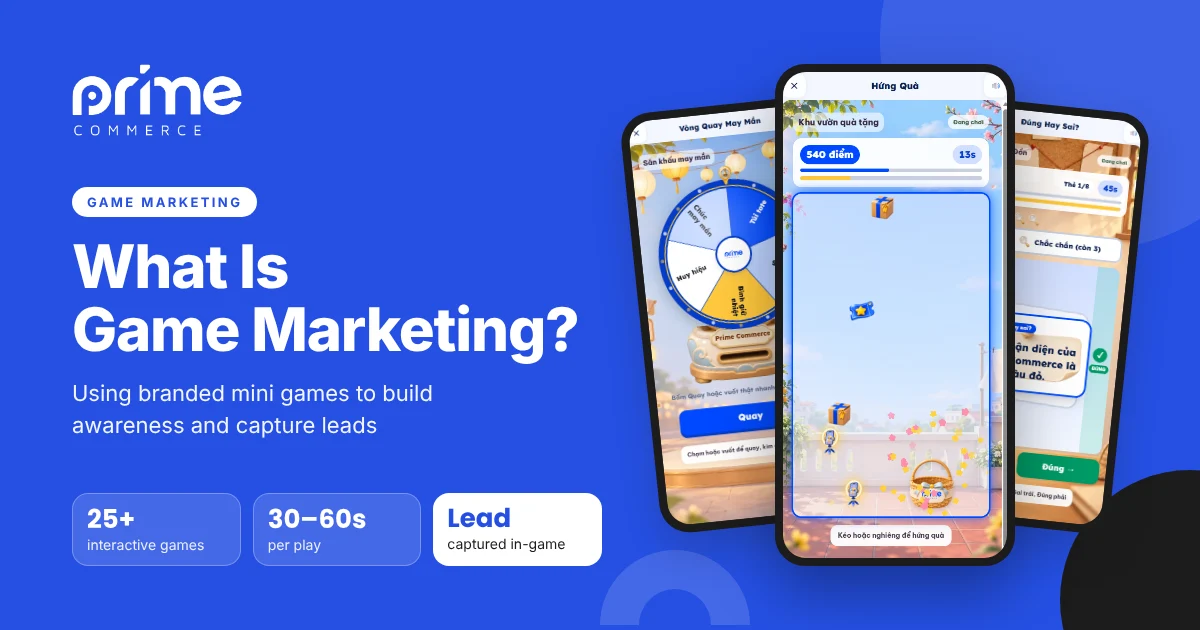
Game marketing has two meanings: marketing a video game to win players and downloads, and using a game to market a brand. For businesses that do not make games, game marketing means using a short branded mini game to attract customers, hold their attention for longer and swap a prize for their contact details. This guide explains both meanings, then covers the 5 main mini game formats, a 6-step process, costs, the KPIs to track and the legal checks to make before launch.
Table of Contents
What is game marketing?
Game marketing (also called a branded game or an advergame) is a form of marketing that uses a game built for a brand as a touchpoint with customers. The game is usually short and runs in a mobile browser, so players do not need to download an app.
The goal of a game marketing campaign is not entertainment. It is to move customers through a deliberate journey: notice the brand, interact with it, leave their details and come back to buy.
Two meanings of game marketing: marketing for games and marketing with games
Search for “game marketing” and you will find both meanings. The table below shows which one you need:
| Criteria | Marketing for a game | Marketing with a game (mini game marketing) |
|---|---|---|
| Who does it | Game studios and publishers | Brands, agencies, retailers |
| What is being sold | The game itself | The brand’s products or services |
| Main activities | User acquisition (UA) ads, app store optimisation (ASO), player communities | Prize-based mini games, lead capture, voucher codes |
| Main metrics | CPI, D1/D7 retention, in-game revenue | Plays, lead rate, CPL, redemption rate |
The rest of this guide focuses on the second meaning: using games as a marketing tool for brands.
How is game marketing different from gamification and in-game advertising?
These three terms are often mixed up. Here is a quick comparison:
| Criteria | Game marketing (branded game) | Gamification | In-game advertising |
|---|---|---|---|
| What it is | A game owned by the brand | Game mechanics (points, badges, leaderboards) added to an existing product | Paid ad placements inside someone else’s game |
| Example | A Lunar New Year catch-the-gifts game on a landing page | Loyalty points or daily missions in an app | Banners or rewarded video in a mobile game |
| Who owns the data | The brand | The brand | The game publisher |
| Main goal | Awareness and lead capture | Retention and usage frequency | Large-scale reach |
In short, gamification adds game elements to an experience that already exists, while game marketing creates a whole game as a piece of brand communication. The two can work together: a mini game with a weekly leaderboard is game marketing that uses gamification.
How does a game marketing campaign work?
A typical campaign takes the player through 5 steps:
- See a link or QR code on social media, in an ad, on packaging or in store.
- Open the game on their phone and play for about 30 seconds.
- Get a result and a prize (discount code, gift or extra spin).
- Fill in a short form (name, phone number) to claim the prize.
- Redeem the code in store or online, or share the game with friends.
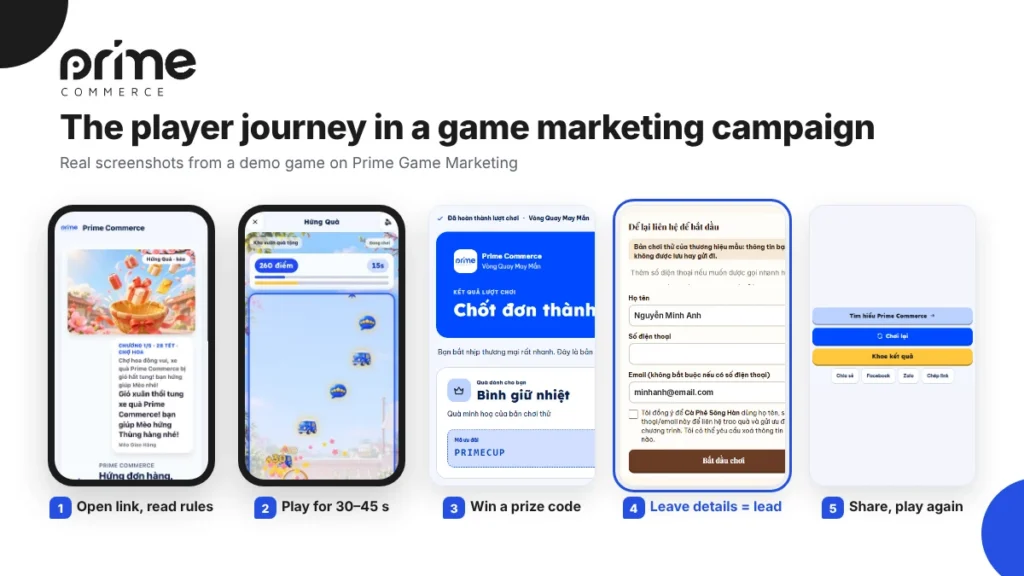
Step 4 is the key: customers leave their details because they want the prize they have just “won”, not because they were asked to.
4 benefits of game marketing for businesses
It holds attention longer than static ads
A post or banner usually gets a few seconds of attention. A mini game keeps people actively engaged for 20–60 seconds, long enough for your logo, hero product and campaign message to appear several times during play.
It captures leads with customer consent
Game marketing produces first-party data: names, phone numbers and emails that customers give you themselves, with consent. This data grows more valuable as third-party cookies are restricted and advertising costs rise.
It earns organic shares
Players like to show off their scores and challenge friends. A simple mechanic such as “share to get an extra play” helps the game spread on its own and lowers reach costs compared with paid ads alone.
Every step of the funnel is measurable
Every game open, completed play, form submission and redemption is recorded. You know exactly where customers drop off and what to fix, which is hard to do with a video ad or a billboard.
5 popular types of mini game marketing
No single format is best for every campaign. Choose based on your goal and where customers will play.
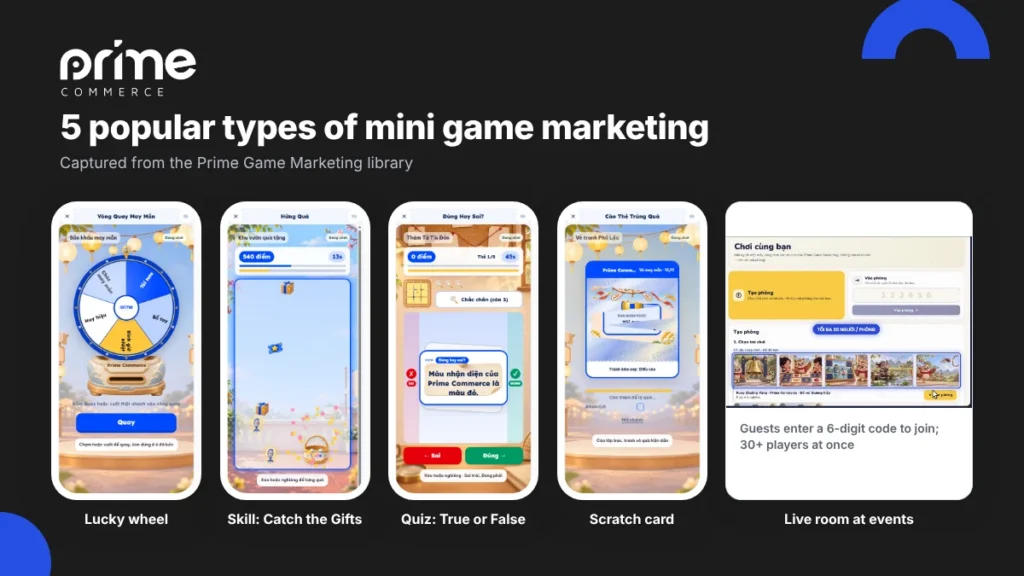
Lucky wheel
The most familiar format: customers spin once to win a random prize. It is easy to understand and suits store openings, brand anniversaries and in-store events. Note that this is a game of chance, so promotion rules are usually stricter (see section 7).
30-second skill games
Catch falling gifts, dodge obstacles, match tiles or grab products. Because the result depends on skill, players feel they “earned” the prize and are more likely to play again. Skill games are a good way to build your product into the gameplay itself.
Quiz
Questions about your product, category or a seasonal theme. A quiz works well when you want customers to learn about features, ingredients or benefits. The answers also help you segment customers by need.
Flip cards and scratch cards
A digital scratch card or a memory game to find matching pairs. Play time is short and suspense is high, which suits discount-code campaigns on e-commerce sites.
Event booth games
A tablet or TV screen at your booth, where visitors scan a QR code or play on the spot and collect a prize at the counter. This format turns booth visits into leads with names and phone numbers, instead of handing out flyers.
Game marketing by industry and peak season
Game marketing works best when it is tied to a specific shopping moment and a clear action after the game.
| Industry / context | How to use a mini game | Suggested prize | Main goal |
|---|---|---|---|
| F&B (coffee chains, restaurants) | Game at the counter or QR code on tables | Discount on the next visit | Repeat visits |
| FMCG | QR code on packaging, product-themed game | Physical gifts, partner vouchers | Awareness and consumer data |
| Retail and e-commerce | Game on website, app or livestream | Free shipping, first-order discount | Order conversion |
| Agencies | Demo game in the client’s brand for a pitch | Not applicable | Win pitches, upsell services |
| Events, fairs, activations | Tablet game at the booth | Small instant prize | Turn booth visits into leads |
| Lunar New Year, Women’s Day, Black Friday | Seasonal game launched 2–4 weeks before the peak | Red envelopes, seasonal vouchers | Catch the search and shopping wave |
For Lunar New Year, lock in the idea and prizes by early December and launch the game 3–4 weeks before the holiday to catch the shopping peak.
A 6-step process to run a game marketing campaign
A game marketing campaign can go live in 1–2 weeks if you use a platform with ready-made game templates. Follow these 6 steps:
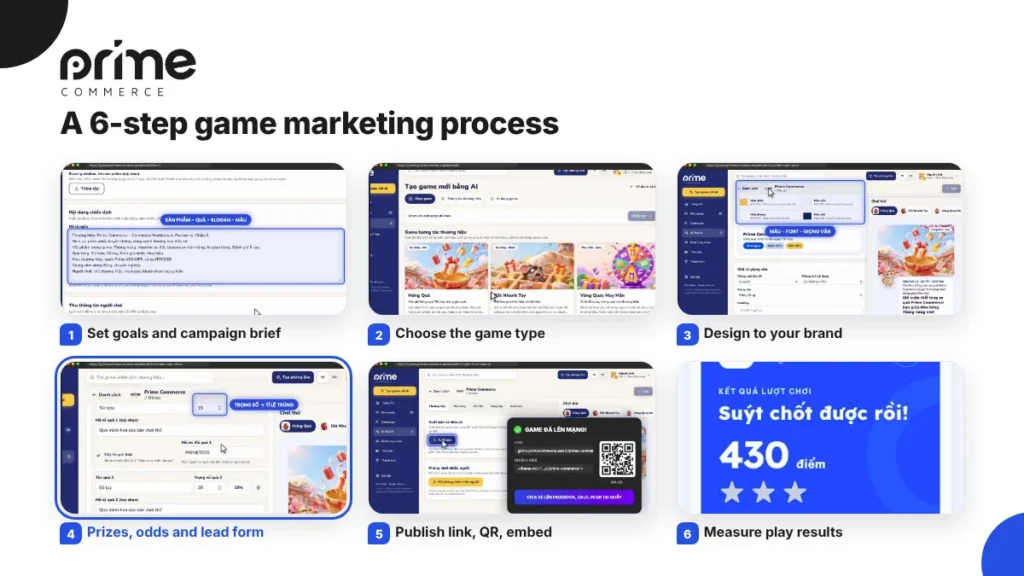
- Set your goal and KPIs. Pick one main goal: awareness, lead capture or sales. Set specific numbers, for example 2,000 plays and 500 leads in 3 weeks.
- Choose the game type. Base it on your goal and where customers will play (mobile, booth, website). Skill games suit awareness; wheels and scratch cards suit voucher campaigns.
- Design to your brand identity. Use your logo, colours, fonts and product images. Players should recognise the brand on the first screen.
- Set up prizes and the lead form. Decide prize quantities, win rates and code expiry dates. Ask for 2–3 fields at most so players do not drop off.
- Distribute across channels. Share the game link on Facebook, LinkedIn, your website, email and messaging apps; print the QR code on packaging, standees and receipts. Paid ads can boost early plays.
- Measure and optimise. Check the numbers daily and adjust prizes, calls to action or channels at the step where most players drop off.
Step 4 should include a test run: play a few rounds yourself and check the form, prize codes and prize flow before going live.
Build a custom game or use a ready-made platform?
This decision has the biggest impact on the cost and timeline of a game marketing campaign:
| Criteria | Custom-built game | Ready-made mini game platform |
|---|---|---|
| Time to launch | Several weeks to several months | About 1–2 weeks |
| Cost | High: design, development, testing, hosting | Lower: pay per plan or per campaign |
| Customisation | Unlimited | Within the game templates; branding, prizes and forms can be changed |
| Best for | Large campaigns, unique mechanics, long-running games | Seasonal campaigns, events, testing many ideas quickly |
If this is your first game marketing campaign, start with a ready-made platform to test customer response before investing in a custom game.
How to measure game marketing: 6 KPIs to track
Measuring game marketing means following customers through each step of the funnel, from seeing the game to redeeming the prize.
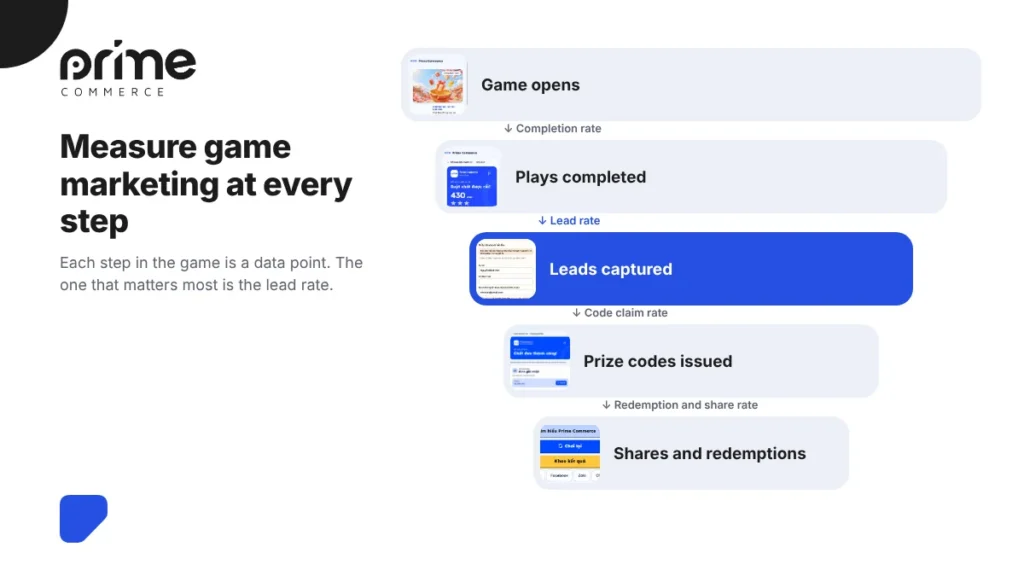
| KPI | How to calculate | What it tells you |
|---|---|---|
| Game opens | Number of times the game page loads | How well your channels and message attract players |
| Completion rate | Completed plays / game opens | Whether the game is clear and engaging enough |
| Lead rate | Valid form submissions / completed plays | Whether the prize is worth sharing details for |
| Cost per lead (CPL) | Total cost / number of leads | How the game compares with other lead channels |
| Redemption rate | Codes redeemed / codes issued | How much real revenue the game drives |
| Share and replay rate | Shares or replays / players | How far the game spreads organically |
Set a separate UTM for each channel (Facebook, LinkedIn, in-store QR code) to see which brings the best leads. Export leads to your CRM regularly so the sales team can follow up within 24–48 hours, while customers still remember the brand.
Legal checks before running a prize game
A game with prizes is usually treated as a sales promotion, so you need to follow promotion and personal data rules in each market where the game runs.
- Promotions: games of chance (wheels, lucky draws) are often regulated more strictly than skill games. In Vietnam, for example, they fall under the Commercial Law and Decree 81/2018/ND-CP and its amendments; depending on prize value and scope, you may need to notify or register with the trade authorities. Other markets have their own rules, so check before launch.
- Terms and conditions: publish clear rules, dates, the prize structure and how to claim prizes inside the game.
- Personal data: the lead form needs a consent clause and should only collect the data you actually need, in line with local data protection law, such as the Personal Data Protection Act in Malaysia or Singapore.
For large campaigns, ask your legal team or a local adviser to review the game before it goes live.
Launch game marketing fast with Prime Game Marketing
The biggest barrier to game marketing is usually development time and cost. Prime Game Marketing solves this by turning your brand guidelines into a 30-second game that is ready to play, with no development team needed.
The video below shows the whole process in about 2 minutes: choosing a game template, uploading your brand guidelines, letting AI build the game and publishing a link for players.
- Ready-made game library: 25+ interactive games such as catch the gifts, quick tap and lucky wheel; each round lasts 30–60 seconds.
- AI game builder: upload your logo and brand guidelines and write a few lines about the campaign; AI builds the game in your colours and fonts, with items and questions, in about 30–90 seconds.
- Built-in prizes and vouchers: set prize quantities, win rates, unique voucher codes, leaderboards and difficulty for each game.
- Lead form: ask for details before or after play; leads go straight to your dashboard and can be downloaded as a CSV for your CRM.
- Live rooms for events: open a room and guests enter a 6-digit code to play together, 30+ players per room.
- Built for agencies: bring a demo game in the client’s brand to your pitch without waiting for developers.
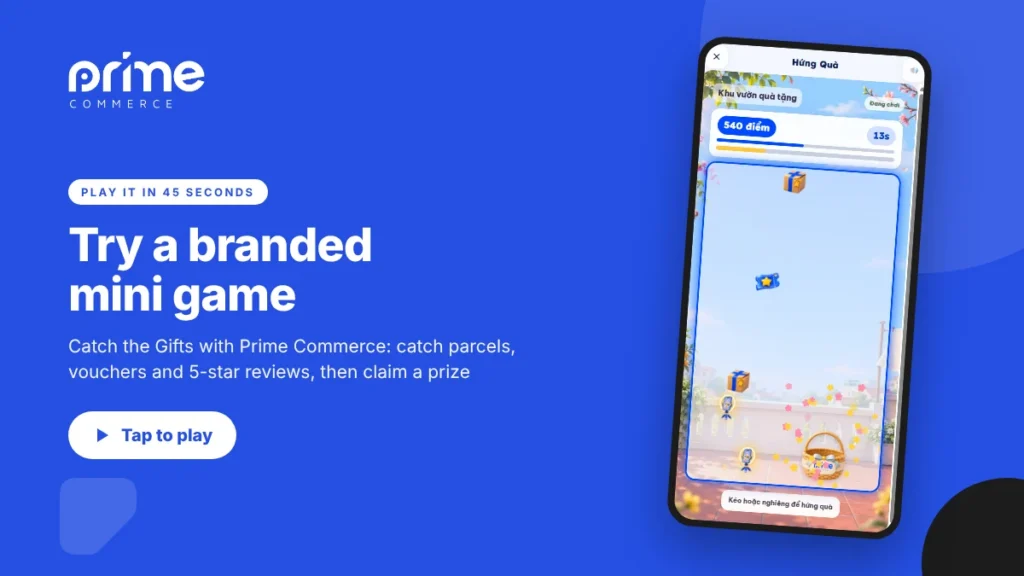
The quickest way to understand game marketing is to play. Try Catch the Gifts with Prime Commerce below: move the basket to catch parcels, vouchers and 5-star reviews in 45 seconds, then claim a prize when you reach the target score.
Prefer to talk to the Prime team directly? Reach us on the channel that suits you:
- WhatsApp: +60 10-253 1767
- Zalo OA: Prime Commerce on Zalo
- Hotline (Vietnam): 0984 896 395
- Email: contact@primecommerce.asia
Game marketing FAQs
What is game marketing?
Game marketing is a form of marketing that uses short branded games (mini games) to attract customers, increase engagement time and capture contact details in exchange for prizes. The games usually run in a mobile browser, with no app download needed.
What is the difference between game marketing and gamification?
Game marketing creates a standalone game as a communication tool, such as a Lunar New Year catch-the-gifts game. Gamification adds game mechanics such as points, badges and leaderboards to an existing product or service, such as a loyalty programme.
How much does a marketing mini game cost?
The cost depends on how you build it. A custom-built game usually takes the most time and budget. A platform with ready-made templates, such as Prime Game Marketing, shortens the timeline and lowers costs considerably. You should also budget for prizes and paid distribution.
How long does it take to launch a game marketing campaign?
With a ready-made template platform, a campaign can be ready in 1–2 weeks, including the idea, branded design, prize setup, testing and launch. A custom game built from scratch usually takes several weeks to several months.
Which industries suit game marketing?
Game marketing suits F&B, FMCG, retail, e-commerce and brands that run frequent events. Agencies also use mini games as demos when pitching campaigns to clients.
Do prize games need to be registered with the authorities?
They may. Games of chance such as lucky wheels and lucky draws are usually regulated as sales promotions. In Vietnam, they fall under the Commercial Law and Decree 81/2018/ND-CP, and depending on prize value and scope you must notify or register with the trade authorities. Check the current rules in each market before launch.
Does game marketing mean marketing for video games?
Yes, that is one of the two meanings. Game marketing can mean marketing a game (a studio promoting a game to win players) or marketing with a game (a brand using a mini game to attract customers and capture leads). For businesses that do not make games, the second meaning is the one that matters.
Conclusion
Game marketing helps brands turn 30 seconds of customer attention into a lead with a name, a phone number and a reason to come back. To make it work, start with a clear goal, choose the right game format, design to your brand identity and measure every step of the funnel.
Want to see what a branded mini game looks like? Play a Prime Game Marketing demo in 30 seconds, or message us on WhatsApp or Zalo to get a demo game in your brand.