


Ecommerce Distribution in Asia: How to Build a Multi-Market Operation That Scales (2026)
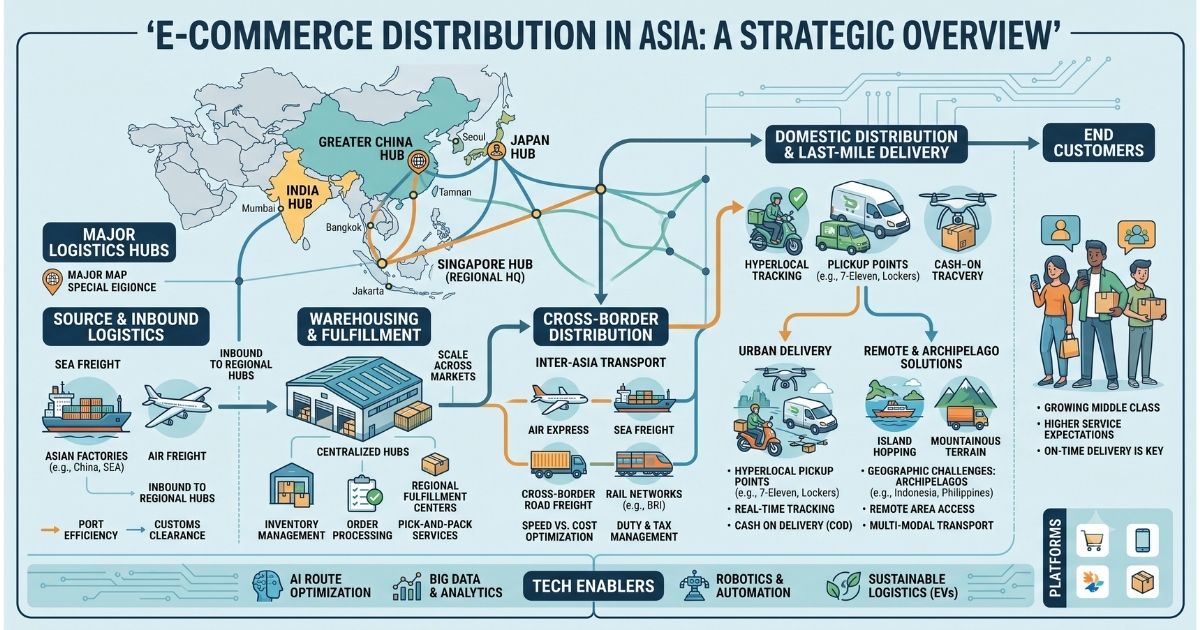
Table of Contents
The gap between being able to sell in a market and being able to deliver in it — consistently, competitively, and profitably — is where most Asian ecommerce expansion plans encounter real friction.
Selling is the visible part of the challenge: building the storefront, optimising the listings, running the campaigns, converting the traffic. Distribution is the invisible infrastructure underneath it. And unlike the visible parts, which a capable agency or internal team can iterate on quickly, distribution failures tend to compound before they surface — through rising landed costs, mounting returns, poor delivery ratings, and customers who do not come back.
This guide covers what ecommerce distribution in Asia actually involves, why the region’s structural characteristics demand a more deliberate approach than most brands initially plan for, and how to build a distribution operation that scales across markets without being rebuilt from scratch each time you add one.
What Is Ecommerce Distribution?
Ecommerce distribution is the end-to-end system that moves products from a brand’s warehouse to the end customer across one or more channels and markets. It encompasses warehousing, inventory positioning, order fulfilment, carrier management, and cross-border logistics — the physical layer that determines whether a brand can deliver on its commercial promises reliably and at competitive cost.
Where a brand chooses to warehouse inventory, which carriers it uses in each market, how it handles customs at borders, and how returns flow back through the system — these are all distribution decisions, and all of them affect the economics and customer experience of every single order.
Distribution vs. Fulfilment: the Distinction That Matters
Fulfilment and distribution are often used interchangeably, but the distinction is operationally meaningful. Fulfilment refers to the single-order process: picking, packing, and shipping a specific order to a specific customer. Distribution is the broader architecture that makes fulfilment possible: how stock is positioned across markets, how inventory is replenished, how the carrier network is structured, and how cross-border flows are managed.
Getting fulfilment right without getting distribution right results in accurate orders that are slow, expensive, or unsustainable to deliver. The operational priority is distribution strategy first, fulfilment execution second.
The Structural Challenges of Ecommerce Distribution in Asia
Asia’s ecommerce opportunity is significant. Its distribution complexity is also significant — and the two facts are directly related. The markets with the highest growth potential tend to be the ones with the most demanding logistics environments.
No Single Logistics Infrastructure Covers the Region
Unlike the European Union, which has relatively standardised customs and carrier infrastructure across member states, or the United States, which operates under a single regulatory environment with a well-developed national carrier network, Southeast Asia is a collection of sovereign markets each with its own logistics ecosystem.
Vietnam’s domestic carrier landscape — dominated by providers like Giao Hàng Nhanh, J&T Express, and Viettel Post — operates differently from Malaysia’s. Indonesia’s archipelago geography creates delivery challenges that simply do not exist in Singapore. The Philippines’ island structure requires multi-carrier strategies for reaching provincial addresses. Japan’s logistics infrastructure is world-class in precision but operates under expectations — packaging standards, delivery window accuracy, proactive tracking communication — far more demanding than most other markets.
No single carrier or logistics provider covers all of Southeast Asia to a consistent service standard. Effective distribution requires a differentiated carrier strategy per market, connected through a logistics management layer that can route orders to the right carrier automatically.
Platform Logistics Is a Starting Point, Not a Strategy
Shopee Logistics Service, Lazada Logistics, and similar platform-integrated fulfilment options make early-stage marketplace selling operationally simple. For a brand testing a new market, they remove the barrier of building a logistics relationship before validating whether the market will perform.
The constraint emerges at scale. Platform-provided logistics is optimised for that platform’s own order flow. It does not extend to orders from other channels, does not provide cross-market inventory management, and does not give the brand the carrier flexibility or cost negotiating leverage that an independent logistics arrangement provides at volume.
Brands that treat platform logistics as their distribution strategy — rather than as a bridge to a more developed setup — typically find their distribution costs do not improve with revenue growth the way they should. The unit economics of platform logistics become progressively less competitive as order volume increases and the brand has no alternative in place.
Import Duties, Customs, and Regulatory Fragmentation
Each Southeast Asian market has its own import duty structure, restricted goods list, and customs documentation requirements. Health supplements face different clearance pathways than electronics. Food and beverage products that are straightforward to import into Malaysia may require additional certification in Indonesia. Beauty products sold into Vietnam require compliance with local cosmetics registration requirements.
Brands that underestimate the customs layer encounter predictable problems: shipments held at clearance, unexpected duty charges applied at delivery, or products flagged as non-compliant and returned to origin. These are not edge cases — they are consistent outcomes for brands entering Asian markets without local regulatory knowledge built into their distribution setup.
The Three Distribution Models for Asian Ecommerce
There is no single correct distribution architecture for Asia. There are three recognisable models, each with different cost and operational profiles, each better suited to particular stages of market maturity.
Centralised Hub-and-Forward
A brand warehouses inventory at a single location — typically Singapore or Hong Kong, both of which offer strong logistics infrastructure and efficient customs environments — and ships cross-border to customers in other markets on demand.
This model is capital-efficient at low order volumes: one warehouse, one inventory pool, minimal in-market setup. Its weaknesses are predictable: cross-border shipping is slower than domestic delivery, landed costs increase with each destination market, and customs exposure is present on every customer order.
For brands testing new markets at low volume, centralised hub-and-forward is a rational starting point. As order volume grows in specific markets, the economics shift in favour of in-market warehousing.
Distributed In-Market Warehousing
The brand holds inventory in local warehouses in each active market. Orders are fulfilled domestically: faster delivery, lower shipping cost, no per-order customs complexity, and access to the full domestic carrier network.
The trade-off is operational complexity: multiple warehouse relationships to manage, inventory split across pools that need independent replenishment, and a higher capital requirement in terms of stock placed in market before demand is fully established.
For brands with consistent, predictable demand in two or more markets, distributed in-market warehousing delivers meaningfully better unit economics than hub-and-forward.
Hybrid: Hub Plus Selective In-Market Stock
Most scaling brands eventually operate a hybrid approach: a regional hub covering newer or lower-volume markets, combined with local warehousing in the markets where demand is established and volume justifies the in-market inventory commitment.
This approach allows brands to add new markets through the hub without prematurely building full in-market logistics infrastructure, while maintaining the economics and delivery performance of local fulfilment in their strongest markets. As a new market matures, the model migrates from hub-forward to in-market without requiring a fundamental restructure.
Building Your Distribution Stack Layer by Layer
Effective ecommerce distribution in Asia is built incrementally. The layers, in the order most brands address them:
3PL Partnerships and Local Carrier Networks
The first layer is how inventory will be held and fulfilled in each target market. For most brands, this means one or more 3PL relationships — third-party logistics providers that warehouse stock and manage domestic fulfilment. The 3PL’s carrier relationships determine delivery performance and last-mile cost. Its WMS and API connectivity determine how orders flow in and fulfilment status flows back to the sales channel.
Choosing the right 3PL in each market is not a commodity decision. In-country presence, marketplace integrations, SLA standards, returns capability, and pricing model vary significantly between providers — and the wrong choice is expensive to reverse once inventory is positioned.
Order Routing and Multi-Location Inventory Management
Once inventory is split across multiple fulfilment locations, an order management system becomes the operational backbone — routing each incoming order to the optimal warehouse based on destination, stock levels, carrier options, and service commitments. Without this routing logic, multi-location distribution creates as many operational problems as it solves.
Cross-Border Logistics and Customs Management
For brands using a hub-and-forward model, or replenishing in-market warehouses with stock shipped cross-border, customs management is a core operational competency — not a peripheral concern. This means: correct HS code classification for every product category, compliant import documentation per destination market, awareness of the duty rate structure and any applicable exemptions, and a resolution pathway when shipments are queried or held.
This is the layer where brands without local expertise most reliably encounter unexpected cost and delay. An established distribution partner with existing customs relationships and documentation processes in place eliminates most of this risk through institutional knowledge rather than trial and error.
Returns Infrastructure
Returns management is the distribution layer most brands build last and regret not building earlier. In Asian ecommerce markets where platform-mandated return policies are often broad and consumer expectations are high, return volumes can be significant — and the economics of processing them vary enormously based on the infrastructure in place.
A functioning returns infrastructure for Asian ecommerce includes: return routing per market (local warehouse or back to origin?), assessed condition protocols (what makes a unit sellable vs. unsellable?), and a data loop that feeds return reasons back into product and packaging decisions to address root causes rather than just processing the symptom.
Distribution Considerations by Market
Distribution execution in Asia is not uniform. Each market has meaningful characteristics that affect carrier selection, cost structure, customer expectation management, and regulatory compliance.
- Vietnam has a highly competitive domestic carrier market with fast delivery performance in Ho Chi Minh City and Hanoi, a strong cash-on-delivery infrastructure (COD remains significant for a meaningful portion of transactions), and more variable performance in secondary and provincial markets. Local carrier relationships and COD capability are operational necessities for brands that want to compete with locally warehoused sellers on delivery speed.
- Malaysia has well-developed ecommerce logistics infrastructure with strong express carrier coverage across Peninsular Malaysia. East Malaysia — Sabah and Sarawak — requires additional planning; delivery times and costs differ significantly from Peninsular. Import compliance for international brands requires careful attention to documentation, and specific product categories face halal certification requirements that must be addressed before distribution begins.
- Singapore functions effectively as a regional distribution hub: efficient port and air freight infrastructure, streamlined customs clearance, a compact geography enabling reliable same or next-day domestic delivery, and strong platform integrations across Shopee and Lazada. For brands entering Southeast Asia, Singapore is often the logical starting point for a regional hub before in-market warehousing in other countries is established.
- Japan operates to the highest delivery standard of any Asian market. Consumers expect narrow delivery windows, pristine packaging with specific presentation standards, and proactive status communication throughout the shipping process. Domestic carriers — Yamato Transport, Sagawa Express — operate to exacting service levels and require specific API integrations. Returns in Japan are less frequent than in some markets, but when they occur must be handled with matching precision to protect seller ratings on Rakuten and Amazon Japan.
When to Use a Distribution Partner vs. Building In-House
Building independently — sourcing 3PLs market by market, establishing carrier contracts, managing customs compliance, building OMS integrations from scratch — is viable for brands with sufficient scale and dedicated logistics management bandwidth. It requires existing market relationships, technical capability, and an acceptance of the learning curve cost in each new market.
Using an established distribution partner compresses the setup timeline, removes the requirement to build local relationships from zero in each market, and provides access to carrier rates negotiated at aggregate volume rather than at a single brand’s level. For brands on an expansion timeline where speed-to-competitiveness matters more than long-run cost optimisation, the partner route delivers reliably faster results.
The practical decision point: if the internal operational cost of building and managing distribution in a new market — including the learning curve, the relationship-building timeline, and the cost of early errors — exceeds the cost of accessing existing infrastructure through a partner, the partner delivers better economics and faster market entry. For most brands entering their first or second Asian market, that threshold is crossed quickly.
Distribution as Part of Commerce Enablement
Distribution does not operate in isolation from the rest of a brand’s commercial operation. The decisions made in the distribution layer directly affect what is possible in the technology layer — OMS routing logic, inventory sync, channel stock visibility — and in the agency layer, where campaign timing, promotional volume commitments, and restocking cycles all depend on distribution capacity being predictable.
Brands that manage distribution as a separate vendor relationship, disconnected from their technology stack and content operations, consistently encounter friction at the integration points: promotional campaigns that exceed fulfilment capacity, inventory data that doesn’t sync in time to prevent overselling, or routing rules that don’t reflect actual in-market carrier availability.
Commerce enablement — technology, agency, and distribution operating as a coordinated system — addresses this integration problem at the architecture level rather than managing it as an ongoing operational workaround.
Frequently Asked Questions
What does ecommerce distribution include?
Ecommerce distribution includes warehousing and inventory positioning across markets, order fulfilment (picking, packing, and shipping), carrier management and last-mile delivery, cross-border logistics and customs management, and returns processing. These form the physical operational layer that moves product from warehouse to customer reliably and at competitive cost.
What is the difference between ecommerce distribution and a 3PL?
A 3PL is a vendor that performs specific distribution functions — typically warehousing, picking, packing, and domestic carrier handoff. Ecommerce distribution is the broader strategy: which markets to warehouse in, how to manage cross-border flows, how to structure returns, and how to connect the physical logistics layer with the technology and sales channel layers above it. A 3PL is one component of a distribution strategy, not the strategy itself.
Should I warehouse inventory locally in each Asian market or ship cross-border?
At low order volumes, cross-border hub-and-forward is simpler and more capital-efficient. As volume in specific markets grows, in-market warehousing delivers faster delivery and better unit economics. Most scaling brands operate a hybrid — in-market stock for established markets, hub-and-forward for newer or lower-volume markets — and migrate each market from hub to local as volume justifies the inventory commitment.
How do import duties work for ecommerce distribution in Southeast Asia?
Each market applies duties based on the product’s HS code classification, at rates that vary by category and country. Documentation requirements, restricted goods lists, and compliance obligations (halal certification, cosmetics registration, health product registration) also differ by market. Brands need compliant import documentation for every cross-border shipment and should model duty costs into their landed cost calculations before launching in a new market.
What is the fastest way to set up ecommerce distribution in a new Asian market?
Working with a distribution partner that already has in-market warehouse relationships, carrier contracts, and customs clearance processes in place is consistently faster than independent builds. For brands working with a commerce enablement partner that includes distribution, the typical setup path from agreement to first in-market fulfilment is four to eight weeks — compared with several months for an independent build in a market where the brand has no existing relationships.
Ready to build your distribution operation across Asia?
Prime Commerce’s Distribution services give brands access to regional fulfilment infrastructure across Vietnam, Malaysia, Singapore, and Japan — with carrier networks, customs management, and 3PL connectivity integrated with technology and agency services from the start.
Prime Commerce is a pan-Asian commerce enablement company providing Technology, Agency, and Distribution services across Vietnam, Malaysia, Singapore, and Japan.