


3PL Ecommerce in Southeast Asia: When to Make the Switch and How to Choose Right (2026)
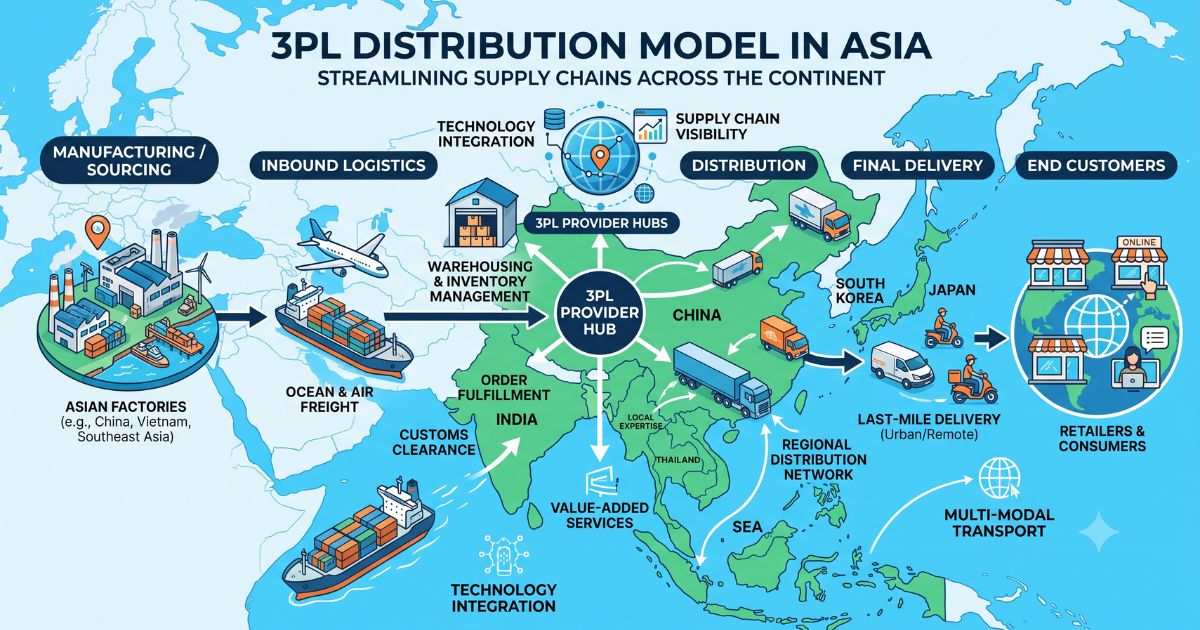
Table of Contents
The point where in-house fulfilment stops making sense rarely arrives with a warning. Most brands discover it after a peak-season backlog, a run of damaged orders, or a unit economics analysis that reveals they are spending more to ship product than they are making on it.
Third-party logistics — 3PL — exists to solve exactly this problem. For ecommerce brands operating in Southeast Asia, where marketplace platform logistics often cannot replace a full distribution network and where the physical complexity of fulfilling across multiple markets is significant, the question is not whether 3PL becomes necessary eventually. It is whether you wait until the pain forces the conversation or structure your logistics from the beginning with the right partner in place.
This guide explains what 3PL actually does in the ecommerce context, why Southeast Asia makes the case for it stronger than most other regions, how to recognise when in-house fulfilment has run its course, and what to look for in a 3PL provider before you sign anything.
What Is 3PL in Ecommerce?
3PL, or third-party logistics, refers to the outsourcing of ecommerce fulfilment operations — warehousing, order picking and packing, shipping, and returns processing — to a specialist provider. Rather than storing and shipping inventory from its own facility, an ecommerce brand sends stock to a 3PL’s warehouse, and the 3PL handles all physical fulfilment from that point.
This arrangement sits at the intersection of physical logistics and technology. The 3PL receives orders via integration with the brand’s sales channels or order management system, picks and packs the relevant products, arranges carrier pickup, and handles the downstream process through to delivery confirmation and, where applicable, return processing.
3PL vs. 2PL vs. 4PL: What the Levels Actually Mean
The “party” designations in logistics describe the number of intermediaries between a brand and its end customer.
- First-party (1PL) means the brand owns and manages its entire logistics operation directly — its own vehicles, warehouses, and staff. Extremely rare in ecommerce outside of the very largest players.
- Second-party (2PL) refers to carriers — shipping companies that transport goods from A to B but do not warehouse, pick, or pack.
- Third-party (3PL) provides warehousing, fulfilment, and shipping coordination — the full physical logistics layer that most ecommerce brands need when they outgrow their own storage and shipping capacity.
- Fourth-party (4PL) adds a strategic management layer on top of multiple 3PLs, coordinating logistics across different providers and markets on the brand’s behalf. Relevant for enterprise operations with very high complexity; not the starting point for most growth-stage brands.
For ecommerce brands in Southeast Asia at the expansion stage, 3PL is the relevant model. Understanding it clearly determines whether your logistics setup supports growth or quietly constrains it.
Why Southeast Asia Makes the Case for 3PL Stronger Than Most Regions
The case for 3PL is well understood in most markets: outsourcing fulfilment frees up capital, reduces operational overhead, and provides logistics expertise without having to build it in-house. In Southeast Asia, each of those advantages is amplified.
Platform Logistics Has Real Limits at Scale
Shopee and Lazada both offer integrated logistics services — Shopee Logistics Service (SLS) and Lazada Logistics are deeply embedded in their respective platforms. For brands selling primarily through one platform in one market, these services can simplify operations considerably.
The constraint emerges when brands try to scale across multiple platforms or markets. Platform-provided logistics is optimised for that platform’s order flow and marketplace structure. A brand selling simultaneously across Shopee, Lazada, and a D2C storefront cannot rely on a single platform’s logistics service to handle all three channels coherently. An independent 3PL, integrated with multiple sales channels via an order management system, provides a neutral fulfilment layer that serves all channels consistently without platform dependency.
Cross-Border Fulfilment Has a High Failure Rate Without Local Infrastructure
Brands that attempt to fulfil cross-border into Southeast Asian markets from a home-country warehouse — without local logistics partnerships — consistently encounter the same predictable problems: unpredictable customs clearance timelines, duty surcharges not modelled into landed cost projections, carrier hand-offs at borders that are not reliably tracked, and return processes that are economically impractical to execute.
A 3PL with established in-country operations in your target markets eliminates most of these variables. Stock is held locally, cleared through customs before it is placed in a customer-facing warehouse, and fulfilled through local carrier networks that know the delivery landscape. The result is lower landed costs, faster delivery times, and dramatically fewer customs-related exceptions.
Last-Mile Delivery Complexity Varies Significantly by Market
Delivery expectations in Singapore are among the highest globally: next-day is standard for most categories, and consumers escalate quickly when orders miss committed windows. Vietnam’s picture is more layered — strong performance in Ho Chi Minh City and Hanoi, considerably more variability in secondary and tertiary markets. Indonesia and the Philippines, as archipelago nations, require multi-carrier strategies and significantly extended lead times for many addresses.
A 3PL with genuine in-country experience in each of your target markets has already navigated these variations. Brands building carrier relationships independently in each new market start from zero — at measurable operational cost and with slower time-to-competitiveness than brands that access existing logistics infrastructure through a 3PL partnership.
5 Signs You Have Outgrown In-House Fulfilment
Not every brand needs a 3PL from day one. But these signals reliably indicate that the cost of continuing without one is rising faster than the savings from keeping fulfilment in-house.
- Fulfilment is consuming more team time than growth-oriented activity. When the operations team spends the majority of its working hours on picking, packing, shipping, and chasing carriers rather than on product, marketing, or commercial strategy, the opportunity cost of in-house fulfilment has become significant.
- Storage constraints are affecting buying decisions. If purchasing decisions are shaped by available warehouse space rather than commercial forecasting and sales data, the logistics setup is constraining the business rather than supporting it.
- Shipping unit economics are not improving with volume. Carrier rates improve with consolidated volume. Fragmented, low-volume shipments across multiple carriers rarely achieve meaningful rate improvements. 3PLs aggregate shipping volume across many clients, accessing better rates than most individual brands can negotiate independently.
- Order error rates are above one to two percent. At this rate, the cost of reshipping, customer service handling, and refunds begins to compound meaningfully. Specialist fulfilment operations are optimised for accuracy in ways that improvised in-house operations rarely are, particularly during high-volume periods.
- You are entering a new market without local logistics infrastructure. This is the clearest signal. Starting a new Asian market operation without in-country fulfilment infrastructure is one of the most common and most costly reasons that expansion projects underperform their projections.
What a 3PL Partner Does — and Does Not Do — for Ecommerce
Understanding the exact scope of a 3PL relationship prevents both under-purchasing and expecting more than the model delivers.
What a 3PL Handles
- Inbound receiving and storage. The 3PL receives stock from your supplier or home warehouse, checks it in against purchase orders, labels it for their WMS, and stores it until orders arrive.
- Order picking and packing. When an order arrives from your sales channel — marketplace, D2C storefront, or OMS — the 3PL picks the relevant SKUs, packs them to your specifications, and generates a shipping label.
- Carrier handoff and tracking. The 3PL selects the appropriate carrier for each shipment based on destination, weight, and service level, and pushes tracking information back to your sales channel.
- Returns processing. When a customer initiates a return, the 3PL receives the returned stock, assesses condition, restocks sellable units, and handles unsellable units according to your policy.
What a 3PL Does Not Handle
3PL covers the physical movement and storage of goods. It does not include: marketplace listing management, customer service and complaints handling, advertising or content production, demand forecasting, procurement, or the commercial relationship with your marketplace account. These remain the brand’s responsibility — or are managed by an agency or commerce enablement partner.
How to Evaluate a 3PL Provider for Southeast Asia
Not all 3PLs operate at the same standard, and the gap between a well-matched and poorly-matched provider shows up in daily operations.
In-Country Presence vs. Hub-and-Forward Models
A 3PL claiming to serve Southeast Asia may mean very different things in practice. Some providers operate a central hub — typically in Singapore — and use forwarding agents for other markets. This introduces exactly the cross-border complexity the brand was trying to eliminate.
Others have genuine warehouse operations in multiple markets, with local staff and established carrier relationships. Ask for specific addresses of operated (not contracted or forwarded) warehouses in each of your target markets. Ask who manages carrier relationships in each country and how returns from, for example, Vietnam are physically processed.
System Integration and Channel Compatibility
The 3PL must integrate with your order management system and your active sales channels. Verify that integrations with your specific marketplaces — Shopee, Lazada, TikTok Shop — are live and operational, not planned. Ask how long integration typically takes, who owns the process, and whether the 3PL has a documented API or uses a middleware connector.
Pricing Structure and Hidden Costs
3PL pricing typically includes: receiving fees (per pallet or unit received), storage fees (per cubic metre per month), pick-and-pack fees (per order or per order line), outbound shipping costs (carrier rate plus handling margin), and returns processing fees. Some providers add account management or WMS access fees.
Request a fully itemised breakdown and run it against your actual order data — average order size, SKU count per order, storage duration, return rate — to calculate realistic landed cost per fulfilled order.
SLA Standards and Operational Reporting
Ask specifically about order cutoff times, accuracy standards (acceptable error rate on outbound orders), and the reporting you will have access to. Real-time inventory visibility and order status tracking at the SKU level are the operational minimum for any brand managing more than a few hundred orders per month.
3PL vs. Commerce Enablement: Understanding How They Fit Together
3PL solves the physical logistics problem: getting product from warehouse to customer efficiently and reliably. Commerce enablement addresses a broader operational challenge — technology integration, content and localisation, platform management, and distribution infrastructure — of which 3PL is one component.
For brands at an early expansion stage, a commerce enablement partner that includes distribution capability in its offering can provide 3PL access without requiring the brand to source and manage a separate logistics vendor. This is simpler operationally and ensures the technology layer — OMS, platform connectors, inventory sync — is integrated with the physical logistics layer from the start, rather than connected as an afterthought.
For brands with more established operations that already have technology and agency services in place, sourcing a dedicated 3PL independently and integrating it with existing systems is a valid path.
The relevant question is not whether to use 3PL, but whether to access it as a standalone provider or as part of a broader commerce enablement arrangement — and which fits your current operational complexity and growth trajectory.
Frequently Asked Questions
What does 3PL stand for in ecommerce?
3PL stands for third-party logistics. It refers to the outsourcing of warehousing, order fulfilment, and shipping to a specialist logistics provider, rather than managing these operations in-house.
What is the difference between a 3PL and a 4PL provider?
A 3PL handles physical logistics directly: warehousing, picking, packing, and shipping. A 4PL adds a strategic management layer on top, coordinating multiple logistics providers across a brand’s supply chain. Most growth-stage ecommerce brands need 3PL; 4PL is more relevant for large enterprises with highly complex, multi-region supply chain requirements.
How much does 3PL fulfilment cost for ecommerce in Southeast Asia?
Cost structure typically includes storage fees (per cubic metre per month), pick-and-pack fees (per order), and outbound shipping costs. Total landed cost per fulfilled order in Southeast Asia generally ranges from USD 3 to USD 8 for standard parcel sizes at modest volumes, improving meaningfully with scale as carrier rate tiers are unlocked.
When should an ecommerce brand switch from in-house to 3PL fulfilment?
The clearest indicators are: fulfilment error rates above one to two percent; storage constraints affecting purchasing decisions; shipping unit economics that are not improving with volume growth; or a new market entry that requires local in-country fulfilment infrastructure the brand does not already have.
Can a 3PL provider handle cross-border ecommerce fulfilment in Southeast Asia?
Yes, but with significant quality variation between providers. A 3PL with genuine in-country warehouse operations in your target markets fulfils locally, avoiding most cross-border complexity. A 3PL that operates a central hub and uses forwarding agents for other markets introduces the same customs delays and carrier risk as self-managed cross-border fulfilment. Always verify in-country presence market by market before signing.
Ready to explore distribution and 3PL options for your Asian expansion?
Prime Commerce’s Distribution services give brands access to regional fulfilment infrastructure across Vietnam, Malaysia, Singapore, and Japan — integrated with technology and agency services so logistics, content, and platform management operate as one coordinated system rather than three separate vendor relationships.
Prime Commerce is a pan-Asian commerce enablement company providing Technology, Agency, and Distribution services across Vietnam, Malaysia, Singapore, and Japan.