


Order Management Systems for Ecommerce Brands Scaling Across Asia (2026)
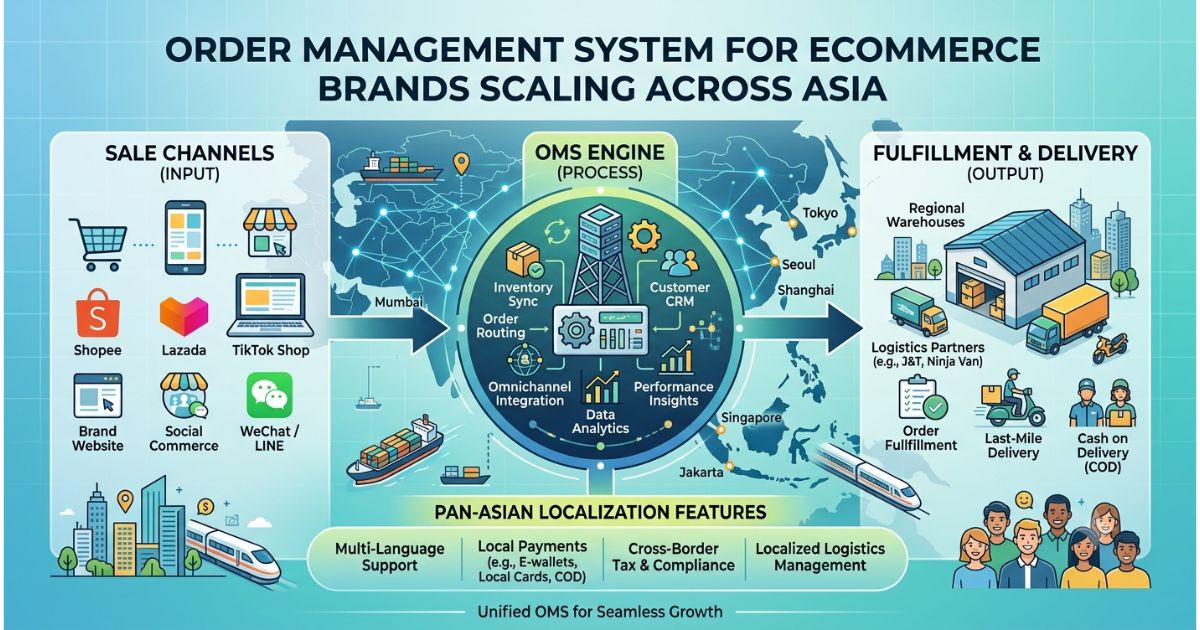
Table of Contents
The moment a brand goes from one marketplace in one market to two marketplaces in two markets, order management stops being a spreadsheet problem and starts being an architecture problem.
In a single-channel, single-market setup, tracking orders manually is painful but workable. The volume is manageable, the logic is consistent, and the occasional error can be caught before it compounds. Add a second platform — a Lazada store running alongside Shopee, for instance — and the data splits across two dashboards, two inventory pools that are not talking to each other, and two sets of performance metrics that require manual reconciliation before they mean anything useful.
Add a third market, a fourth platform, and a 3PL in a country the brand’s team has never operated in, and what was a manageable operational burden becomes a systemic failure mode. Orders get misrouted. Inventory oversells. Shipments hit the wrong carrier. Returns arrive at warehouses that have no process for receiving them.
An order management system is the technology layer built specifically for this problem — and for ecommerce brands scaling across Asia’s fragmented marketplace landscape, it is one of the most operationally significant investments a growth-stage business can make.
What Is an Order Management System?
An order management system (OMS) is software that centralises and automates the lifecycle of a customer order — from placement through to fulfilment, shipping, and returns. It consolidates orders from multiple sales channels and marketplaces into a single operational view, routing each order to the correct fulfilment location and triggering the right logistics process automatically.
The “system” part matters more than it sounds. Without an OMS, brands typically manage orders through a patchwork of platform-native seller dashboards, manually cross-referencing inventory between them and using disconnected tools for different markets. The OMS replaces this patchwork with a single source of truth: every order, from every channel, visible and actionable in one place.
OMS vs. Basic Order Tracking
Platform-native order management — the order management screens in Shopee Seller Centre, Lazada Seller Centre, or TikTok Shop’s seller interface — is not an OMS. These tools are designed to manage orders within that platform’s own ecosystem. They have no visibility into orders from other platforms, no ability to cross-reference inventory across locations, and no logic for routing orders to the optimal fulfilment point.
A standalone OMS sits above the platform layer, pulling orders from all active channels and making routing decisions based on rules the brand has configured — consistently, at volume, without manual intervention.
Why Asian Ecommerce Amplifies OMS Complexity
The case for an OMS exists in most ecommerce markets. In Asia, the case is considerably stronger — because the structural characteristics of the region create operational complexity that basic order management tools simply cannot handle at scale.
Multi-Platform Order Flows
Western ecommerce brands often build their operations around a single dominant platform — Amazon in the US, for example — where mastering one system largely determines performance. In Southeast Asia, no single platform occupies that position.
A brand actively selling across Shopee, Lazada, TikTok Shop, and its own D2C storefront is managing four distinct order sources, each with its own API, its own logistics integration, its own promotional mechanics, and its own reporting environment. Without an OMS, orders from each source require separate handling. The team logs into four dashboards, processes orders from each, and attempts to maintain accurate inventory counts across all of them simultaneously. As order volume grows, the error rate on this manual process increases predictably.
Multi-Market Inventory Allocation
A brand warehousing stock in two locations — Singapore and Vietnam, for instance — needs to decide, for every order, which warehouse to fulfil from. The logic depends on the delivery destination, the available stock at each location, the carrier options in play, and the service level commitment attached to the order.
Without an OMS, this decision happens manually for every order. With an OMS, a rules-based routing engine makes it automatically — optimising for speed, cost, or whichever parameters the brand has prioritised.
Currency, Tax, and Carrier Routing Differences
An order placed on Shopee Vietnam, paid in Vietnamese Dong, fulfilled from a Ho Chi Minh City warehouse, and handed to a Vietnamese last-mile carrier involves a very different operational chain than an order placed on Lazada Malaysia, paid in Ringgit, and fulfilled from Kuala Lumpur. An OMS handles the routing logic, the currency tracking for reporting, and the correct carrier assignment for each scenario — without requiring the brand to manually manage each combination.
Core Functions of an Ecommerce OMS
Not all OMS platforms are built identically, but most established systems share a core set of capabilities that define the category.
Centralised Order Ingestion and Routing
The OMS connects to each sales channel via API, native integration, or middleware, pulling in all orders in near real time. Each incoming order is processed against the brand’s configured routing logic: which warehouse to fulfil from, which carrier to use, what SLA applies, and whether any exception handling is required.
Real-Time Inventory Visibility Across Locations and Channels
As orders are confirmed and fulfilled, the OMS decrements inventory across all connected warehouses and sales channels simultaneously. A sale on Shopee Vietnam reduces the available stock displayed on Lazada Malaysia automatically — preventing the overselling event that triggers seller rating penalties, customer complaints, and, in severe cases, marketplace account warnings.
Cross-channel inventory sync is one of the highest-impact OMS functions for brands managing multiple platforms. Overselling is both commercially damaging and nearly inevitable at scale without automated inventory management.
Fulfilment Logic and 3PL Integration
For brands working with one or more third-party logistics providers, the OMS sends fulfilment instructions to the 3PL’s warehouse management system automatically. The 3PL picks, packs, and ships; tracking information flows back into the OMS and is pushed upstream to the original sales channel — without manual handoff at any point in the chain.
This automation eliminates a significant manual processing step and, more importantly, means fulfilment velocity is not constrained by the brand team’s own processing capacity during peak periods.
Returns Management
Returns are one of the most consistently under-engineered parts of ecommerce operations. An OMS with returns management capability receives the incoming return, logs it against the original order, updates inventory based on assessed product condition, and triggers any customer credit or refund process. For brands managing returns across multiple markets and platforms, automated returns processing materially reduces both labour cost and error rate.
Unified Reporting and Cross-Channel Analytics
Because an OMS consolidates order data from all channels, it provides the only genuinely unified view of ecommerce performance across a multi-platform, multi-market operation. Revenue by channel, fulfilment cost by market, return rates by SKU, and carrier performance by region are all visible from a single reporting environment — rather than requiring manual aggregation from multiple platform dashboards.
OMS vs. ERP vs. WMS: Understanding the Stack
The relationship between an OMS and the systems adjacent to it causes persistent confusion, particularly for brands coming from offline or early-stage ecommerce backgrounds.
- An ERP (Enterprise Resource Planning) system manages the financial and operational record of the business: accounting, procurement, supplier management, and financial reporting. Most ERPs have some order management capability, but this is typically designed for B2B or wholesale order flows, not high-volume direct-to-consumer ecommerce.
- A WMS (Warehouse Management System) manages physical operations inside a warehouse: bin locations, picking routes, inbound receiving, and stock counts. The WMS knows where every unit is in the building. It does not know which sales channel an order came from or how to route it.
- An OMS sits between the sales channel layer and the physical fulfilment layer. It receives orders from sales channels and routes them to the appropriate WMS or 3PL for physical execution — then reports back upstream on fulfilment and shipping status.
In a mature ecommerce stack, all three systems are connected: the OMS feeds order and revenue data to the ERP for financial reconciliation and sends fulfilment instructions to the WMS or 3PL for physical execution. For growth-stage brands, the OMS is typically the first dedicated system investment; ERP integration tends to follow when the business reaches significant revenue complexity.
When Do You Actually Need an OMS?
An OMS adds operational value from the point where the complexity it resolves begins to exceed the cost of the system and the effort of implementation. In practice, this threshold is reliably reached when:
- You are actively selling on more than two platforms or in more than one market. The inventory sync and order routing functions of an OMS deliver their clearest ROI once two or more order sources need to share a single inventory pool and different fulfilment paths apply to different orders.
- Your team is spending meaningful time each day managing orders across platform dashboards. When manual order management consumes significant team time, the opportunity cost of not automating it is real — and scales with order volume.
- You have experienced, or are at risk of, an overselling event. Running out of a product because two platforms sold the same units simultaneously is the most reliable signal that platform-native inventory management has reached its limit.
- You are about to enter a new market or add a new fulfilment location. The routing logic required for multi-location, multi-market fulfilment is where an OMS delivers its most complex value — and where the absence of one creates the highest operational risk during the critical early weeks of a market launch.
How to Evaluate an OMS for Southeast Asian Operations
Not all OMS platforms are built with Asian marketplace infrastructure in mind. This matters when the platforms your buyers use most heavily — Shopee, Lazada, TikTok Shop, Rakuten Japan — are the ones requiring integration.
- Marketplace integration depth. Ask whether the integration with each target platform is native and maintained directly by the OMS vendor, or delivered through a third-party middleware layer the vendor does not control. Native integrations are typically more reliable and update faster when platform APIs change — which they do, regularly, across Asian marketplaces.
- Multi-currency and multi-market support. If you are selling across Vietnam, Malaysia, and Japan simultaneously, the OMS must handle multiple currencies in its order data without requiring manual conversion for reporting. Ask to see examples of cross-market dashboards from current clients operating in your target countries.
- 3PL and warehouse connectivity. If you are using or planning to use a 3PL, confirm that the OMS integrates with that specific provider. Generic warehouse connectivity standards exist, but implementation quality varies significantly. Ask for the vendor’s list of confirmed 3PL integrations in each of your target markets and whether those integrations are maintained or one-time builds.
- Implementation timeline and ongoing support. OMS implementation involves API connections to every active sales channel, configuration of routing rules, staff training, and — for brands with existing operations — a data migration process. Ask for realistic timelines based on the specific channels and markets you need active on day one, and whether local support is available in your operating markets.
OMS as Part of a Broader Commerce Enablement Stack
An OMS is the technology layer that makes multi-channel, multi-market ecommerce operationally manageable. But it is one component of a broader architecture — not a complete solution on its own.
The brands that execute consistently well across Asia typically operate an OMS that is integrated with their agency layer (so promotional campaigns on one platform don’t create inventory exceptions on another) and with their physical distribution layer (so 3PL fulfilment instructions flow automatically and tracking information returns to the sales channel without manual handoff).
This integration across technology, agency, and distribution — where each component is aware of and connected to the others — is what distinguishes a commerce enablement approach from three separately managed vendor relationships.
Frequently Asked Questions
What is the difference between an OMS and an ERP?
An ERP manages the financial and operational record of the business — accounting, procurement, and supplier management. An OMS manages the order lifecycle from placement to fulfilment and returns across multiple sales channels. For ecommerce, the OMS handles daily operational decisions about how orders are routed and fulfilled; the ERP handles the financial reconciliation of those transactions. The two systems are typically integrated rather than alternatives to each other.
Do I need an OMS if I only sell on one marketplace?
Not typically. Platform-native order management tools are sufficient when operating on a single marketplace in a single market. The OMS case becomes compelling once you add a second sales channel or a second market — creating inventory sync and order routing complexity that the platform’s own tools cannot resolve.
How does an OMS integrate with Shopee and Lazada?
Integration is delivered via each platform’s published API. The OMS connects to Shopee Seller Centre and Lazada Seller Centre, pulls in order data in near real time, and pushes fulfilment status and tracking information back as orders are processed. Integration quality varies by OMS vendor — ask specifically whether each integration is native or delivered via middleware, and how frequently it is updated when platform APIs change.
What is the typical cost of an ecommerce OMS?
SaaS-based OMS platforms typically charge a monthly subscription based on order volume, starting from a few hundred USD per month at smaller order volumes and scaling upward. Some platforms charge a percentage of GMV processed. Implementation costs for API connections and configuration are generally separate from the subscription fee and can be significant for multi-channel, multi-market setups.
How long does OMS implementation typically take?
A straightforward setup — two or three channels, one warehouse, one market — typically takes four to eight weeks. More complex configurations involving multiple markets, 3PL integrations, and ERP connectivity can take three to six months. The timeline depends heavily on the API documentation quality of each sales channel, the complexity of the routing rules required, and the implementation support provided by the OMS vendor.
Ready to streamline order management across your Asian ecommerce operations?
Prime Commerce’s Technology services provide brands with order management infrastructure integrated across all active sales channels and markets — so inventory, orders, and fulfilment operate as a single coordinated system from the start.
Prime Commerce is a pan-Asian commerce enablement company providing Technology, Agency, and Distribution services across Vietnam, Malaysia, Singapore, and Japan.