
The Ecommerce Technology Stack for Brands Selling in Asia: What You Actually Need (2026)
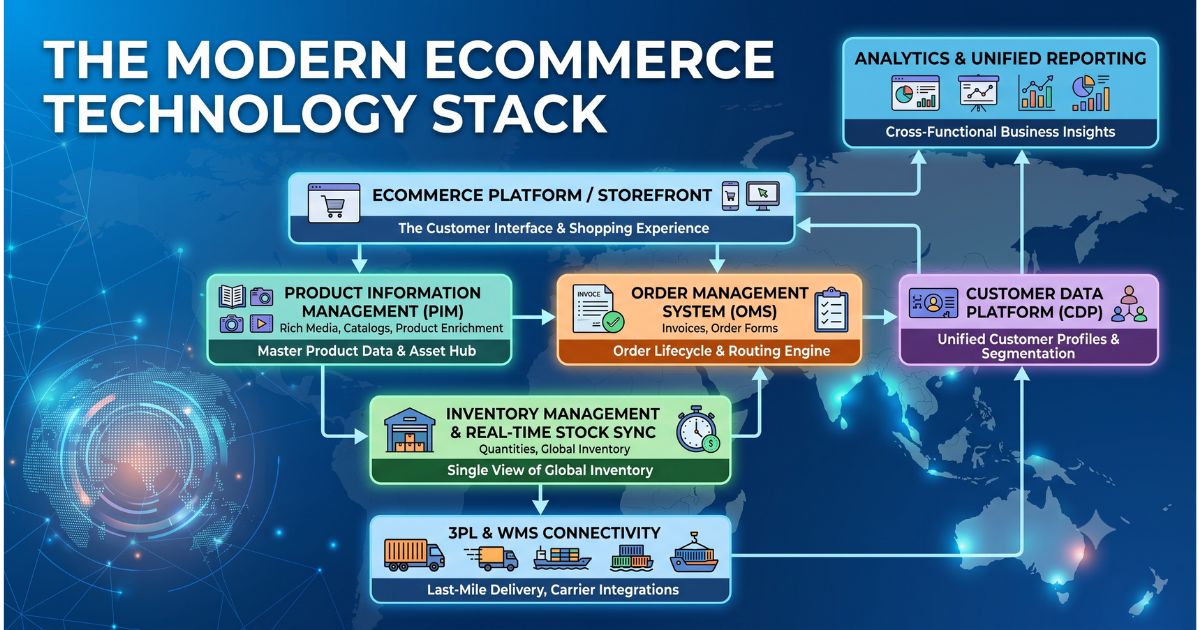
Table of Contents
Ecommerce technology decisions made early in a brand’s Asian expansion tend to stay with the business longer than the people who made them. The order management system chosen when the brand was live on one marketplace in one market becomes increasingly expensive to replace when the operation has scaled to five channels across three markets — even when that system was the wrong choice for where the business is today.
Technology debt accumulates quietly. A manual inventory sync that worked at 200 orders per month creates compounding oversell risk at 2,000. A reporting setup that required one analyst to reconcile three spreadsheets weekly requires three analysts and four spreadsheets at scale — and still does not give the business the cross-channel visibility it needs to make confident decisions.
The brands that scale well across Asia are not necessarily the ones that chose the most sophisticated technology at the start. They are the ones that chose the right architecture — systems that could connect to the channels they needed, extend to the markets they entered, and be replaced or upgraded at a single layer without rebuilding everything above and below it.
This guide covers the ecommerce technology stack that Asian operations actually need, how the layers connect, where brands consistently make mistakes, and how to audit whether what you have in place is fit for where you are going.
What Is an Ecommerce Technology Stack?
An ecommerce technology stack is the collection of software systems that power a brand’s online selling operations — from the storefront and order management system through to inventory management, customer data, and analytics. Together, these systems determine how efficiently orders flow, how accurately inventory is tracked, and how effectively the brand can market to and retain its customers.
The “stack” framing is useful because it implies layers, and layers are the right mental model. Each system sits at a specific level of the operation — some at the customer-facing layer (the storefront), some at the operational core (the OMS), and some at the data layer (analytics, CDP). Understanding which layer each system occupies and what it needs to connect to above and below it is the foundation of a sound technology architecture decision.
Core Layer vs. Supporting Layer
Not all technology in a brand’s ecommerce operation carries equal weight. The core layer includes systems whose failure immediately stops revenue: the storefront, the order management system, and the inventory management layer. These need to be reliable, well-integrated, and capable of handling the brand’s expected order volumes with headroom.
The supporting layer includes systems that amplify performance when working well but do not immediately halt operations when they fail: marketing analytics, customer data platforms, product information management, and reporting infrastructure. These can be built out progressively as the core layer stabilises — and it is typically more effective to build them that way than to attempt full-stack implementation simultaneously.
Why Technology Decisions Matter More in Asian Ecommerce
Every ecommerce operation requires a technology stack. In Southeast Asia, the stakes of getting it right — and the consequences of getting it wrong — are amplified by three structural characteristics of the regional market.
Platform Fragmentation Multiplies Integration Requirements
A brand selling on Amazon in the US typically needs one marketplace integration and one logistics integration. A brand selling across Shopee, Lazada, TikTok Shop, and a D2C storefront in Southeast Asia needs four marketplace integrations, each with its own API specification, authentication process, and data format. Add a second market and the Shopee Vietnam integration is a different API endpoint from Shopee Malaysia, with market-specific differences in product attributes, shipping options, and promotional mechanics.
Each integration is a dependency — a point where a platform API change, a version deprecation, or a rate limit error can break the flow of orders, inventory updates, or fulfilment status into the brand’s operational systems. The more integrations in the stack, the more integration maintenance it requires, and the more important it becomes that the core technology layer is built on a foundation that handles this maintenance at scale.
Asian Marketplace APIs Update Frequently
Shopee, Lazada, and TikTok Shop update their seller and product APIs far more frequently than Amazon or established Western platforms. New fields become mandatory. Authentication methods change. Promotional APIs are versioned. Rate limit policies are updated. An integration built twelve months ago may require significant maintenance work today to remain functional at the current API specification.
Brands building their own custom integrations directly against marketplace APIs carry the maintenance burden of tracking and implementing these updates continuously. Brands using established middleware platforms or commerce enablement partners with managed integrations transfer this burden to a provider whose core business is maintaining it.
The Data Silo Problem
Marketplace platforms in Southeast Asia are designed to keep customer data within their ecosystems. Shopee and Lazada do not share buyer email addresses or identifiable buyer data with sellers. This creates a structural data gap: the majority of a brand’s transactions generate no first-party data the brand can use for marketing, CRM, or customer lifetime value analysis.
The technology implication is that brands need a deliberate strategy for building a first-party data asset alongside their marketplace revenue — typically through D2C channel development, loyalty programme mechanics, and post-purchase communication flows. This requires a customer data layer that is designed for the Asian context rather than assumed from a Western ecommerce playbook where email capture from marketplace transactions is more readily available.
The Core Ecommerce Technology Stack for Asian Operations
What follows is not the maximum possible stack — it is the practical stack that a brand scaling across two or more markets in Asia needs to operate effectively. Each layer is described with its function, its importance, and what to look for when selecting a solution.
Ecommerce Platform / Storefront
The storefront is the brand’s owned digital property: a website or app where customers can browse and purchase directly. In Southeast Asia, the storefront is rarely the primary revenue channel — that role typically belongs to Shopee and Lazada. But the storefront is the only channel where the brand captures first-party customer data directly and controls the full experience without a platform intermediary.
For most brands entering Asia, Shopify remains the most practical starting point for D2C: it has established integration pathways to Shopee and Lazada, a wide ecosystem of apps, and is well-understood by development partners across the region. Brands with higher customisation requirements or operating at scale in specific markets sometimes choose headless commerce architectures — separating the frontend experience from the backend commerce engine — but this adds significant development complexity and should be evaluated carefully relative to the operational benefit at each stage.
Order Management System (OMS)
The OMS is the operational core of a multi-channel ecommerce operation in Asia. It consolidates orders from every sales channel — every marketplace account, the D2C storefront, and any other order source — into a single management layer, applies routing logic to determine how each order should be fulfilled, and pushes fulfilment status back to the originating channel.
For a brand selling on one marketplace in one market, an OMS is optional. For a brand selling on three channels across two markets, it is essential. Without it, inventory allocation across channels is manual and error-prone; order routing to the right fulfilment location requires constant manual judgment; and cross-channel reporting requires manual data aggregation that is always at least partially out of date.
Full guide to order management systems for Asian ecommerce →
Product Information Management (PIM)
A PIM system maintains the master record for every product the brand sells: name, description, images, specifications, variant data, pricing, and any market-specific or platform-specific localised content. From the PIM, product data is distributed to every channel — marketplaces, the D2C storefront, and any third-party distribution partners.
Without a PIM, product data lives in a different form in each channel: the Shopee listing may have attributes that the Lazada listing is missing; the D2C product description may be six months behind the updated marketplace version; the Vietnamese market listing may have been localised but not updated when the product specifications changed. These inconsistencies create customer experience problems, content quality penalties from platform algorithms, and operational overhead as teams try to keep multiple versions of product data in sync manually.
For brands with fewer than 100 SKUs, a well-governed master spreadsheet can serve as a lightweight PIM. Beyond that threshold, a dedicated PIM system — even a lightweight one — delivers immediate operational return.
Inventory Management and Real-Time Stock Sync
In an omnichannel operation, inventory is a shared resource across all active channels. The technology layer that manages this shared resource — allocating stock to channels, decrementing it as orders are placed, flagging low-stock conditions before they cause oversells — is the most operationally consequential system in the stack.
Real-time inventory sync across all active channels is the standard that the operation should be working toward. The most damaging technology failure mode in Asian ecommerce is not a storefront outage — it is an oversell event during a major promotional period, where multiple channels sell the same units simultaneously because the inventory system has not updated quickly enough.
3PL and WMS Connectivity
For brands working with one or more third-party logistics providers, the technology stack must include a data connection between the OMS and the 3PL’s warehouse management system. When an order is confirmed, the OMS needs to send a fulfilment instruction to the 3PL’s WMS; when the 3PL ships the order, the tracking information needs to flow back through the OMS and be pushed to the originating sales channel automatically.
The quality of this OMS-to-WMS integration determines whether fulfilment automation is actually autonomous or still requires manual handoffs at key steps. Ask any 3PL for the technical specification of their WMS integration — specifically whether they provide an API or require file-based transfer — before committing to a logistics partnership.
Customer Data Platform (CDP)
A CDP aggregates customer data from every channel where it can be collected — the D2C storefront, post-purchase surveys, loyalty programme interactions, email open and click data, and any in-market customer service interactions — and creates unified customer profiles that can be used for segmentation, personalisation, and marketing optimisation.
In the context of Asian ecommerce, where marketplace platforms limit the first-party data brands can collect, the CDP is the system that makes a D2C investment strategically coherent: the data collected through owned channels creates the capability for customer marketing that marketplace channels cannot provide.
A full CDP implementation is a later-stage investment for most brands — not a day-one priority. The priority sequencing is: OMS and inventory management first; PIM and product data standardisation second; customer data infrastructure third.
Analytics and Unified Reporting
The reporting layer that sits across all active channels and systems is what makes the stack legible to the business. Without consolidated cross-channel reporting, the data that exists is siloed — Shopee performance in one dashboard, Lazada in another, D2C in a third, with no common denominator that allows the brand to understand total revenue, total fulfilment cost, or customer-level behaviour across the full operation.
The reporting infrastructure does not need to be a sophisticated data warehouse from the start. A well-designed dashboard that pulls from the OMS and key channel sources into a unified view of the most important metrics — revenue by channel, fulfilment cost by market, inventory velocity by SKU, return rate by category — provides the operational visibility needed to make decisions confidently.
How the Layers Connect: the Integration Problem
A technology stack is only as effective as the integrations between its components. Each system needs to send and receive data from the systems adjacent to it — and in Asian ecommerce, with its multiple marketplace APIs and diverse 3PL landscape, the integration layer is where the most technical complexity and the most maintenance overhead lives.
Platform Connectors and Middleware
Most brands do not build direct API integrations to every marketplace from their core systems — the maintenance overhead is too high given how frequently Asian marketplace APIs change. Instead, they use middleware platforms: integration services that maintain the API connections to each marketplace and present a standardised data interface to the brand’s OMS and other core systems.
Established middleware platforms that serve the Southeast Asian market include Linnworks, ChannelAdvisor, Akeneo (for PIM connectivity), and various regional providers with deeper local marketplace integrations. The critical evaluation criterion is: which specific marketplace integrations does the platform actually maintain, and how quickly do they update when Shopee or Lazada changes their API?
API-First Architecture
The practical implication of “API-first” for ecommerce technology in Asia is: choose systems that expose a documented, stable API, and treat API connectivity as a selection criterion rather than a nice-to-have. Systems that require custom development to connect to adjacent tools, or that lock data behind proprietary export formats, create integration costs that compound significantly as the operation scales.
Build vs. Buy vs. Partner: Three Approaches to Ecommerce Technology
How a brand accesses its ecommerce technology stack determines both the upfront investment required and the ongoing operational cost of maintaining it.
- Building custom — developing proprietary integrations, custom OMS logic, or bespoke PIM systems — maximises control and specificity but carries the highest development cost, the longest implementation timeline, and the highest ongoing maintenance burden. It is viable for brands at significant scale with dedicated engineering teams. For most growth-stage brands entering Asia, it is the most expensive way to solve a problem that established off-the-shelf solutions already address adequately.
- Buying off-the-shelf — selecting established SaaS platforms for each function and integrating them — is the standard approach for brands building their stack independently. It delivers faster time-to-operation than custom builds and transfers much of the maintenance burden to the software vendors. The challenge in the Asian context is that many established Western ecommerce SaaS platforms have weaker integration coverage for Shopee, Lazada, and TikTok Shop than for Amazon, Shopify, or European platforms — requiring additional middleware or custom integration work.
- Accessing technology through a commerce enablement partner — working with a partner that provides OMS infrastructure, platform integrations, and reporting as part of a managed service — transfers the build, maintenance, and upgrade burden to a partner whose core capability is exactly this. For brands that want to focus on their product, brand, and commercial strategy rather than ecommerce infrastructure management, this approach compresses the time-to-operational-effectiveness significantly.
The Most Common Technology Stack Mistakes in Asian Ecommerce
Choosing a platform for its Western marketplace integrations and discovering the Asian integrations are underdeveloped. Many globally recognised OMS and ERP platforms have strong Amazon and Shopify connectivity but limited or poorly maintained Shopee and Lazada integrations. Verify Asia-specific integration quality before committing, not after.
Building core systems on manual processes that cannot scale. A brand that is managing inventory allocation across multiple channels with a shared spreadsheet and manual updates is not running a technology stack — it is managing risk manually. The spreadsheet works until it doesn’t, and the event that reveals it doesn’t is typically a high-stakes promotional period.
Buying the most sophisticated available solution before the operation is ready for it. A CDP is a sound investment at a certain scale. It is a distraction and a cost at a stage when the brand has not yet built a meaningful first-party data asset to put into it. Sequencing technology investments to match operational maturity is as important as choosing the right systems.
Neglecting the reporting layer. The most common gap in ecommerce technology stacks in Asia is not a missing system — it is a missing unified view of what the whole operation is doing. Brands that cannot answer basic cross-channel questions — what is my total revenue across all channels today? what is my fulfilment cost per order by market? — cannot optimise confidently, regardless of how well-chosen their individual systems are.
Frequently Asked Questions
What technology do I need to start selling ecommerce in Southeast Asia?
At minimum: a marketplace seller account on your primary target platform (Shopee or Lazada), a method of managing orders and inventory within that platform (the platform’s native seller tools are sufficient at low volume), and a product catalogue with platform-compliant images and listings. As volume grows and additional channels are added, an OMS and inventory sync layer become the next priority investments.
Do I need an order management system from day one?
Not necessarily. Platform-native seller tools are adequate for a single marketplace in a single market at modest order volumes — typically up to a few hundred orders per month. The OMS becomes necessary when you add a second channel or market, because the inventory sync and order routing logic that the OMS provides is the primary mechanism for preventing oversell events and managing fulfilment across multiple sources.
What is the difference between a PIM system and an OMS?
A PIM (Product Information Management) system manages product data — names, descriptions, images, specifications — and distributes that data to sales channels. An OMS (Order Management System) manages the lifecycle of customer orders — from placement through fulfilment, shipping, and returns. They operate at different layers of the stack and are complementary, not alternative, investments.
How do I integrate Shopee and Lazada into my existing technology stack?
Integration is typically achieved via each platform’s published API, either through a direct integration built by a developer or through a middleware platform that maintains connections to both marketplaces and presents standardised data to your OMS or ERP. The key evaluation criterion is whether the middleware provider actively maintains and updates the Shopee and Lazada integrations when those platforms update their APIs — which they do frequently.
Should I build my own ecommerce technology stack or use a commerce enablement partner?
Building independently gives the highest degree of control and can achieve better economics at significant scale, but requires meaningful development investment, ongoing maintenance overhead, and technical expertise that most brands at the growth stage do not have in-house. A commerce enablement partner that provides technology infrastructure as part of its service model transfers the build, integration, and maintenance burden to a specialist and delivers operational effectiveness faster. The right choice depends on the brand’s internal technical capability, the timeline pressure of market entry, and the complexity of the channel and market footprint being built.
Ready to build the right technology foundation for your Asian ecommerce operation?
Prime Commerce’s Technology services provide brands with order management infrastructure, platform integrations, and unified reporting across Vietnam, Malaysia, Singapore, and Japan — integrated with agency services and distribution capability so the full operation runs as a coordinated system from the start.
Talk to Prime Commerce about your ecommerce technology stack →
Prime Commerce is a pan-Asian commerce enablement company providing Technology, Agency, and Distribution services across Vietnam, Malaysia, Singapore, and Japan.