


How to Sell on Shopee: A Complete Guide for Brands in Southeast Asia (2026)
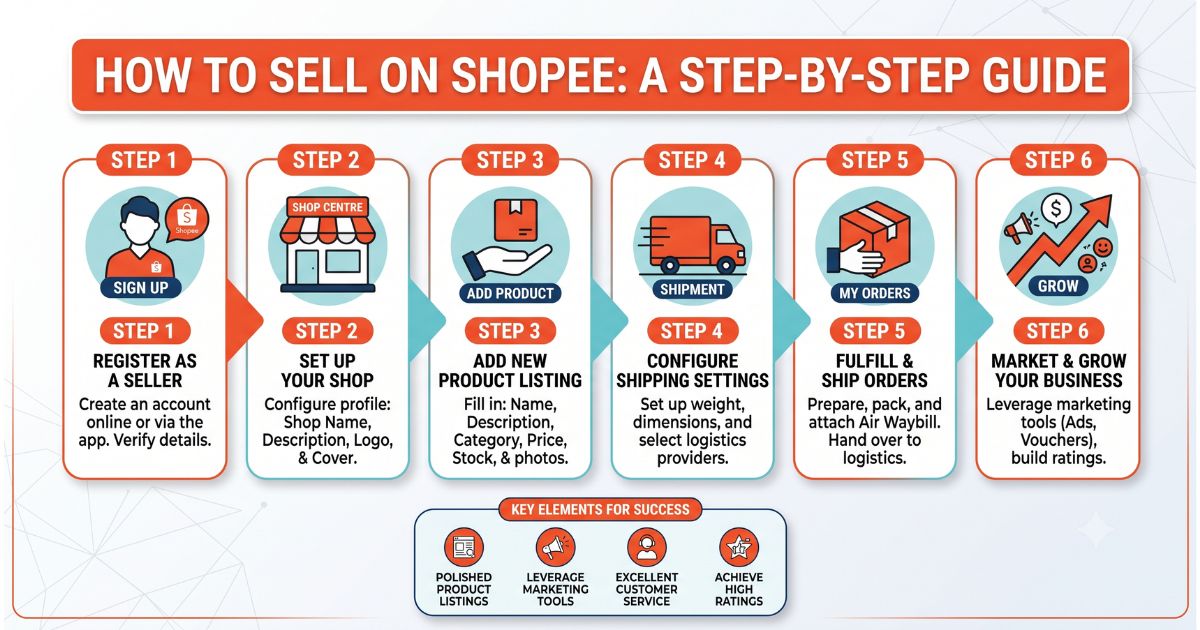
Table of Contents
Shopee is the most visited ecommerce marketplace across most of Southeast Asia. In Vietnam, Malaysia, Thailand, the Philippines, and Indonesia, it is where the majority of online shoppers go first — to search, compare, read reviews, and ultimately buy. For any brand building a regional ecommerce presence, it is not a channel to consider. It is the baseline.
That does not mean selling on Shopee is simple. A live account is not the same as a performing account, and the gap between the two is larger than most brands expect before they experience it. Shopee’s search algorithm, promotional mechanics, advertising system, and seller performance scoring each have their own logic — and getting them right simultaneously, across one or more markets, takes operational capability that goes beyond simply uploading products and waiting for orders.
This guide covers everything a brand needs to know to set up, optimise, and scale a Shopee presence in Southeast Asia — from account registration through to advertising strategy, seller metrics management, and the point at which managing Shopee in-house starts to constrain rather than support growth.
What to Know About Shopee Before You Start
Shopee’s Reach Across Southeast Asian Markets
Shopee operates across seven Southeast Asian markets — Singapore, Malaysia, Vietnam, Thailand, the Philippines, Indonesia, and Taiwan — as well as Brazil and Mexico. While the platform shares a name and underlying architecture across all markets, each country operates as a separate instance: separate seller accounts, separate listing requirements, separate promotional calendars, and separate logistics integrations.
A brand wanting to sell in Vietnam and Malaysia simultaneously needs two Shopee seller accounts — one registered under a Vietnamese business entity or through Shopee’s cross-border seller programme, and one under a Malaysian entity. This is a structural reality of the platform that brands planning multi-market presence need to account for from the start.
Shopee Marketplace vs. Shopee Mall
Shopee operates two tiers of seller accounts. The standard Shopee Marketplace tier is open to any verified seller and is the entry point for most new brands. Listings display the seller’s store name and are subject to the full competitive marketplace environment.
Shopee Mall is a curated tier for verified brands and authorised distributors. Mall listings carry a badge that signals authenticity to buyers and typically benefit from higher search visibility and conversion rates, particularly in the health, beauty, and electronics categories where counterfeit risk is a known concern. Qualification for Mall requires documentation of brand ownership or authorised distribution status and is reviewed by Shopee’s brand protection team.
For brands with registered trademarks in their target markets, applying for Shopee Mall status as early as possible is worth the effort. The trust signal it provides pays compounding returns in conversion rate over time.
How to Set Up a Shopee Seller Account
To sell on Shopee, register at seller.shopee.com, complete business verification with your company registration documents, set up your store profile, upload product listings with Shopee-compliant images and descriptions, and configure your shipping options. New seller accounts are typically live and able to accept orders within one to three business days of completing verification.
The registration process differs slightly by market. In Vietnam (banhang.shopee.vn) and Malaysia (seller.shopee.com.my), the process requires: a valid company registration document, a business bank account, a contact phone number for OTP verification, and a national ID or passport for the primary account holder. For brands registering as cross-border sellers — selling into a market from a registered entity in another country — Shopee’s cross-border seller programme has separate documentation requirements.
Key Setup Decisions That Affect Performance From Day One
- Store name. Once set, your Shopee store name is difficult to change and affects search visibility. Use your brand name exactly as registered, avoid generic descriptors, and keep it consistent with your presence on other platforms.
- Shipping configuration. Shopee’s seller fulfilment options include Shopee-integrated carriers (SLS, J&T, and others depending on market) and self-arranged shipping. For most new sellers, using Shopee-integrated carriers is simpler operationally and provides buyers with trackable, Shopee-supported delivery. Brands with higher order volumes should evaluate self-arranged shipping for cost and control reasons once volume justifies the carrier relationship.
- Payment and bank setup. Shopee releases seller payouts on a rolling basis, typically seven to fourteen days after order completion. Ensure the bank account linked to the seller account can receive transfers in the local currency of the market you are selling in.
Building Listings That Actually Convert
A Shopee listing is not a product description — it is a document optimised simultaneously for Shopee’s search algorithm and for human buyers deciding whether to purchase. These two audiences have overlapping but not identical requirements.
Title and Keyword Optimisation for Shopee Search
Shopee’s search algorithm weighs the product title heavily for keyword matching. Titles can be up to 120 characters and should front-load the most important search terms: product type, brand name, key specification or variant, and any attributes that buyers in that market commonly search for.
A weak title: “Premium Vitamin C Serum by BrandX, 30ml, For Glowing Skin”
A stronger title: “BrandX Vitamin C Serum 30ml — Brightening Anti-Aging Face Serum, Dermatologist Tested”
The stronger title leads with the product category and brand, includes the primary search term early, and adds variant and claim specifics that capture longer-tail searches. Avoid keyword stuffing — Shopee’s algorithm is sophisticated enough to penalise obvious manipulation, and titles that read unnaturally damage conversion rate even when they surface in results.
Images and Video
Shopee’s current listing specifications require a square primary image (minimum 500x500px, recommended 1000x1000px or larger) on a white or plain background. Additional images can show product in use, key ingredients or specifications, and size or variant comparisons. A product video — between nine and sixty seconds — significantly increases engagement and conversion in Shopee’s algorithm weighting, particularly for beauty, health, and consumer electronics categories.
Images matter more than most first-time Shopee sellers expect. In a search results page where ten competing products are displayed simultaneously, visual distinctiveness determines which listings receive clicks — and click-through rate directly affects search ranking.
Attributes and Category Selection
Completing all available product attributes — not just the mandatory ones — improves search visibility for attribute-filtered searches and signals listing quality to Shopee’s algorithm. Selecting the most specific available category rather than a broader parent category is equally important: a serum listed under “Health & Beauty” instead of “Skincare > Serums & Essences” will rank behind more precisely categorised competitors for relevant searches.
Pricing and Shopee’s Price Sensitivity
Shopee’s buyer base is price-sensitive across most markets. This does not mean lowest price always wins — brand credibility, review count, and delivery terms all factor into purchase decisions — but it does mean that pricing that is significantly above comparable products without a clear justification (brand tier, product differentiation, review volume) typically underperforms.
Monitor competitor pricing actively in your category, particularly in the weeks leading up to major sale events when promotional pricing decisions need to be made with awareness of what the competitive landscape looks like.
Shopee’s Promotional Mechanics
Shopee’s promotional calendar is one of the most aggressive of any ecommerce platform globally. Understanding its structure is essential for planning inventory, pricing, and marketing spend.
Vouchers and Discounts
Shopee’s seller voucher system allows brands to issue percentage or absolute discounts redeemable at checkout. Vouchers can be configured for store-wide use, category-specific use, or single-product use, and can require a minimum order value. They are a primary tool for increasing average order value and accelerating purchase decisions among buyers in the consideration phase.
Platform-level Shopee vouchers (funded by Shopee, not the seller) also exist and can boost visibility to voucher-seeking buyers. Sellers accepted into Shopee’s voucher programme gain additional distribution in Shopee’s deals and promotion sections.
Campaign Participation: Flash Deals and Mega Sales
Shopee runs a promotional event on or around the ninth of every month (3.3, 4.4, 5.5 and so on) with the flagship events — 9.9, 10.10, 11.11, and 12.12 — being the highest-traffic and highest-competition periods of the calendar year.
Participation in major campaign events is not automatic. Brands need to apply for campaign slots in advance — typically several weeks before the event — and need to meet minimum seller rating and account health requirements to be eligible. Products entered into campaigns need confirmed stock well ahead of the event to avoid fulfilment failures during peak traffic.
Missing 11.11 because of inadequate preparation is one of the most avoidable and most commonly made strategic errors by brands on Shopee. The event consistently drives more volume in a 24-hour period than most brands generate in a full month of ordinary trading.
Shopee Advertising: Getting Visibility Beyond Organic
Organic search ranking on Shopee is increasingly competitive. In most product categories, the top positions in search results include a mix of organically ranked listings and paid Search Ad placements. Brands that do not invest in advertising are effectively ceding the most visible positions in search results to competitors who do.
Search Ads
Shopee Search Ads operate on a cost-per-click model. Brands bid on keywords, and when a buyer searches for a matching term, the listing can appear in sponsored positions at the top of search results. The key levers are keyword selection (targeting terms with high purchase intent rather than high search volume alone), bid management (balancing CPC against the return on ad spend the category and product can support), and quality score (Shopee’s estimate of listing quality, which affects ad placement efficiency).
Discovery Ads
Discovery Ads surface products to buyers based on browsing behaviour rather than explicit keyword searches — appearing on Shopee’s home page, in category feeds, and in the “Recommended for You” section. They are particularly effective for brand awareness and for reaching buyers who are in the consideration phase but have not yet searched for the product specifically.
Budget Allocation
New sellers entering Shopee advertising should start with Search Ads on a small number of high-intent keywords before expanding. A common mistake is spreading budget too thin across too many keywords and too many ad formats simultaneously — the result is insufficient data to optimise and no single product getting enough exposure to build meaningful performance history.
Seller Metrics and Account Health
Shopee evaluates every seller account against performance metrics that directly affect both listing visibility and eligibility for promotional campaigns. The key metrics to monitor:
- Response rate and response time. Shopee expects sellers to respond to buyer messages within 24 hours. Consistently missing this target lowers your response rate metric, which is publicly visible on your store page and affects buyer confidence. During peak periods — around major sale events — response time requirements become harder to meet and require active customer service coverage planning.
- Seller rating. A composite score based on product ratings, shipping speed, and fulfilment accuracy. A seller rating below 4.5 out of 5 begins to affect search ranking and campaign eligibility in most markets. Ratings below 4.0 can trigger account restrictions in some categories. Review accumulation is slow early in an account’s life; managing returns and disputes well before ratings accumulate is the most efficient way to protect your long-run rating.
- Late shipment rate. The percentage of orders where the first carrier scan happens after Shopee’s required handoff window. Consistently high late shipment rates result in account penalties. If using Shopee-integrated carriers, this is largely within Shopee’s logistics ecosystem; if using self-arranged shipping, it is the seller’s direct operational responsibility.
Managing Shopee Alongside Other Channels
Shopee rarely operates as a brand’s only sales channel for long. As the operation grows, managing Shopee alongside Lazada, TikTok Shop, and a D2C storefront requires shared inventory management and coordinated promotional planning — not independent operation of each channel as a separate P&L.
The operational infrastructure that makes this manageable is an order management system that syncs inventory across all active channels in real time, so a sale on Shopee does not trigger an oversell on Lazada, and a promotional event on one platform does not leave another channel understocked.
Running marketplace operations across Shopee, Lazada, and TikTok Shop →
When to Work with a Shopee Management Partner
The operational demands of a high-performing Shopee account — listings continuously optimised, promotions planned weeks in advance, advertising actively managed, customer service covered to Shopee’s response standards, and seller metrics monitored — exceed what most brand teams can sustain alongside other business functions.
The threshold varies by brand, but most find that managing more than one market on Shopee, or managing Shopee alongside two or more other platforms, requires either a dedicated internal team or an external managed service. Managed marketplace partners bring platform expertise, existing relationships with Shopee’s brand team (which affects campaign access and issue resolution speed), and operational systems that are built for multi-account management rather than adapted from single-account workflows.
What marketplace management across Southeast Asia involves →
How commerce enablement connects Shopee management to distribution and technology →
Frequently Asked Questions
How long does it take to set up a Shopee seller account?
Registration and basic setup takes a few hours. Business verification — the review of company registration documents by Shopee’s seller onboarding team — typically takes one to three business days. From the point of verification, sellers can begin uploading listings immediately, though new accounts without established seller ratings typically need two to four weeks of active selling before organic search ranking becomes meaningful.
Do I need a local business entity to sell on Shopee in each Southeast Asian market?
Not necessarily. Shopee’s cross-border seller programme allows brands to sell into specific markets from a registered entity in another country. However, cross-border seller accounts typically face lower search visibility than locally registered sellers, and buyers in some markets are less likely to purchase from cross-border accounts. For brands with serious volume ambitions in a specific market, a locally registered business entity and in-market inventory typically deliver meaningfully better performance than cross-border selling.
What is Shopee Mall and how do I qualify?
Shopee Mall is a curated tier for verified brand owners and authorised distributors. Mall listings carry an authenticity badge that improves buyer confidence and typically benefits from higher search visibility and conversion rates in competitive categories. Qualification requires documentation of brand ownership (trademark registration) or authorised distribution status, submitted through Shopee’s brand portal. Review timelines vary by market, but most applications receive a decision within two to four weeks.
How does Shopee advertising work and what budget should I start with?
Shopee Ads operates on a cost-per-click model for Search Ads and a CPM or cost-per-click model for Discovery Ads. Starting budgets vary widely by category and market — in highly competitive categories like beauty or electronics, effective Search Ad bids can be several thousand VND or equivalent per click, while less competitive categories are significantly cheaper. New advertisers should start with a focused set of high-intent search keywords, a daily budget they are comfortable losing while learning, and plan to optimise based on actual performance data over the first four to six weeks before expanding.
How do I manage Shopee alongside other marketplaces without overselling?
Real-time inventory synchronisation across all active sales channels is the operational requirement. Without it, a sale on Shopee will not be reflected on Lazada until the next manual update — creating the overselling risk that damages seller ratings and triggers order cancellations. An order management system (OMS) that connects all active channels and decrements inventory simultaneously across all of them is the standard solution for brands managing more than one platform.
Ready to build and scale your Shopee presence in Southeast Asia?
Prime Commerce’s Agency services include Shopee account management across Vietnam, Malaysia, and Singapore — with listing optimisation, promotional campaign execution, advertising management, and seller metric monitoring integrated with technology and distribution operations.
Talk to Prime Commerce about Shopee management →
Prime Commerce is a pan-Asian commerce enablement company providing Technology, Agency, and Distribution services across Vietnam, Malaysia, Singapore, and Japan.