


Omnichannel Commerce in Asia: How to Unify Your Selling Channels and Scale (2026)
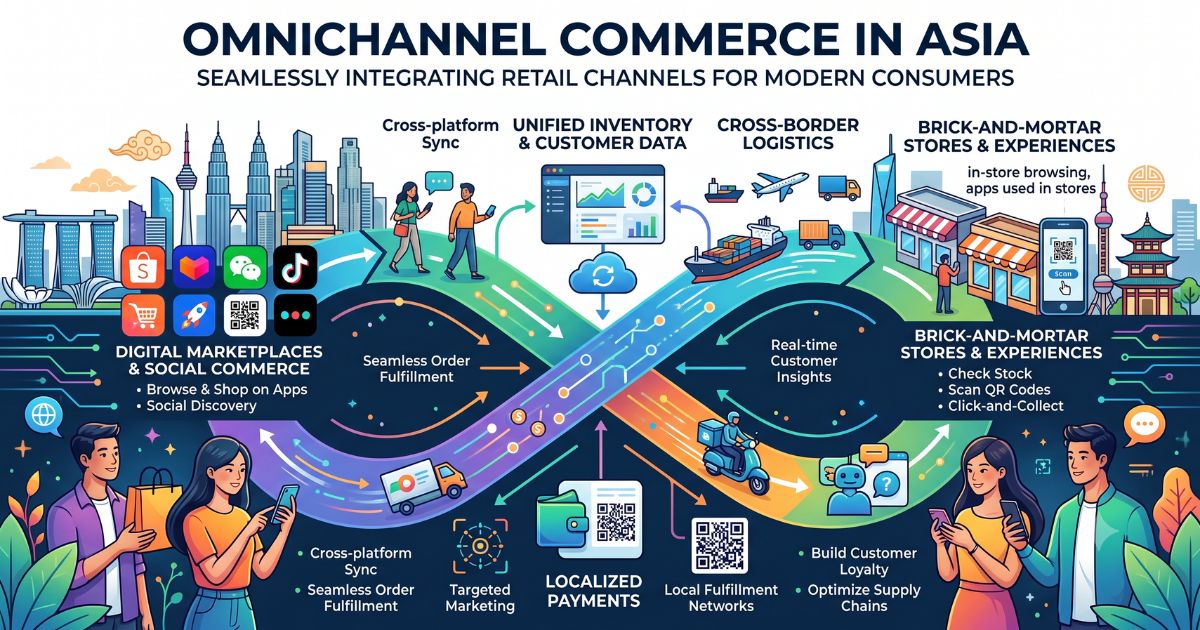
Table of Contents
The premise of omnichannel commerce sounds straightforward: be present everywhere your customer wants to buy, and make the experience consistent across all of it. The execution, in Southeast Asia particularly, is where most brands discover how much operational infrastructure that premise actually requires.
The challenge is not simply having accounts on multiple platforms. Most brands with serious Asian market ambitions are already doing that. The challenge is connecting those accounts — inventory, pricing, customer data, fulfilment — into a coherent system that behaves consistently across Shopee, Lazada, TikTok Shop, a D2C storefront, and wherever else the customer happens to encounter the brand.
Without that connection, what looks like an omnichannel presence from the outside is actually several disconnected single-channel operations running in parallel — each managed separately, each carrying its own inventory risk, each generating data that never talks to the others. This is multichannel. It is not omnichannel, and the difference matters increasingly as Asian consumers’ expectations for consistency and immediacy continue to rise.
This guide covers what omnichannel commerce means in the Asian market context, what operational architecture it requires, where brands most commonly fail in the build, and how to approach the sequencing correctly.
What Is Omnichannel Commerce?
Omnichannel commerce is an approach to selling that connects all of a brand’s sales channels — marketplaces, D2C storefronts, social commerce, and physical retail — into a unified operational system. Rather than running each channel independently, it ensures that inventory, pricing, and customer data operate consistently across every touchpoint in real time.
The word “unified” is the operational key. A brand live on Shopee, Lazada, its own website, and TikTok Shop but managing each independently — separate inventory pools, separate promotional strategies, no shared customer data — is multichannel. A brand where a purchase on any channel immediately updates stock everywhere else, where a customer’s purchase history is visible regardless of where they bought, and where promotions are coordinated to avoid conflicts is omnichannel.
Omnichannel vs. Multichannel: the Critical Difference
Multichannel means being available on multiple channels. Omnichannel means those channels are operationally connected. The difference is not semantic — it determines whether the brand is building compounding operational advantage or running parallel operations each carrying its own overhead and risk.
Most brands start multichannel. The investment required to move from multichannel to omnichannel is significant — but so is the performance gap between the two at scale, particularly in a region as platform-fragmented as Southeast Asia.
Why Omnichannel Matters More in Asia Than in Most Markets
The case for omnichannel commerce exists in every market. In Southeast Asia, the imperative is considerably stronger, for three structural reasons that do not apply with the same force in Western markets.
Asian Consumers Move Fluidly Between Channels
In Western ecommerce, the majority of the customer journey tends to happen within a single channel — a shopper discovers a product on Google, clicks through to Amazon, and purchases without touching a second platform. In Southeast Asia, the journey is far less linear.
A consumer in Vietnam might discover a skincare product through a TikTok video, look it up on Shopee to read reviews, check the brand’s own Instagram for more content, and then purchase on Lazada because they have a voucher. This cross-channel journey — which is not unusual, it is representative — means a brand with no coherent presence across all those touchpoints loses influence at every point where its data stops.
Brands that can track this journey, even partially, and connect the data points across channels understand their customers’ decision-making at a level that single-channel operators cannot. That understanding compounds into better targeting, better content, and better conversion over time.
Platform Fragmentation Makes Consistency Harder — and More Valuable
Western omnichannel strategies typically build around one or two dominant platforms plus a D2C channel. In Southeast Asia, the relevant platform set is larger, more fragmented, and changes faster. Shopee and Lazada split marketplace dominance across most markets. TikTok Shop is growing rapidly in Vietnam, Thailand, and Indonesia. Tokopedia dominates in Indonesia alongside Shopee. LINE Shopping is relevant in Thailand.
Each platform has its own pricing rules, promotional mechanics, and content formats. Maintaining consistent pricing across all of them simultaneously — without running conflicts that undermine one channel or violate another’s promotional terms — requires operational coordination that multichannel setups rarely achieve.
Mobile-First Shopping Raises the Bar on Experience
Southeast Asian consumers are among the most mobile-native shoppers in the world. In Vietnam and Indonesia, the majority of ecommerce traffic originates from mobile devices, and a significant portion of that traffic moves between apps in a single session — from social media to marketplace to messaging — sometimes without a clear boundary between content consumption and purchase intent.
This mobile-first, app-hopping behaviour means brand inconsistency is immediately visible. A product image that looks different between platforms, a price that varies unexpectedly, a promotion on one channel but not another — each of these is noticed by a consumer moving between apps far more readily than by someone encountering each channel separately on a desktop at different times. Omnichannel consistency is, in this context, increasingly a credibility baseline rather than a differentiator.
The Architecture of an Omnichannel Commerce Operation
Omnichannel does not happen at the interface level — it happens at the infrastructure level. The consistency a customer experiences is produced by operational systems underneath that keep every channel synchronised.
A Unified Product Catalogue
The foundation of omnichannel is a single source of truth for product information: names, descriptions, images, specifications, pricing, variants, and any market-specific localisation. Without this, product information diverges across platforms as different teams make different updates — inconsistencies compound over time and become expensive to unwind.
A product information management (PIM) system — or even a rigorously maintained master product record at smaller scale — provides the source from which all platform listings are populated and updated. When a product changes, the change flows from the master catalogue to all channels, rather than requiring manual updates on each platform separately.
Real-Time Inventory Visibility Across Channels
Real-time inventory sync is the most operationally critical element of omnichannel commerce. When a unit sells on Shopee, every other channel must reflect that immediately. Without real-time sync, the probability of overselling — two channels selling the same unit simultaneously — increases with every channel added to the portfolio.
Overselling is the most damaging operational failure in marketplace management: it triggers cancellations, seller rating penalties, customer trust damage, and in some cases platform warnings or account restrictions. At omnichannel scale, with significant order volume across multiple channels, it compounds rapidly.
Centralised Order Management
Orders from every channel need to flow into a single operational view — an order management system that processes each order against the same inventory pool, applies consistent routing logic, and provides a consolidated picture of fulfilment status and performance across all channels.
Without centralised order management, coordination overhead scales with each additional channel, and the error rate increases proportionally. The OMS is the connective tissue between the channel layer and the physical fulfilment layer.
Consistent Customer Data and Recognition
In a genuine omnichannel operation, a customer who purchased on Shopee and now visits the brand’s D2C website is a known customer — not an anonymous new visitor. This requires a shared customer data layer: a customer data platform or equivalent that aggregates purchase history, preference data, and interaction data across channels.
Building this layer in Southeast Asia is complicated by one structural reality: Shopee and Lazada do not share buyer identity data with sellers. The brand knows an order was placed but cannot identify the buyer in a way that connects to their own CRM. Brands building omnichannel customer data capabilities in Asia typically do so through loyalty programmes, post-purchase communication flows, and D2C channel development that captures identifiable first-party data they can actually activate.
Coordinated Fulfilment
Omnichannel order management is only as valuable as the fulfilment infrastructure behind it. If orders from different channels are fulfilled from separate inventory pools with different carrier relationships, the claimed inventory unification breaks down at the physical layer. Distribution infrastructure — how stock is positioned across markets, how 3PL relationships are structured, how returns flow — must be designed with omnichannel routing in mind from the start.
Omnichannel in Practice: Channels to Connect in Southeast Asia
An omnichannel strategy in Asia typically needs to account for a broader channel set than in most Western markets.
- Marketplaces — Shopee, Lazada, TikTok Shop. The primary revenue channels for most brands in Southeast Asia. Each has its own seller interface, promotional calendar, and algorithm. Effective omnichannel management means these channels share inventory and are managed with awareness of each other’s pricing and promotional activity, not as independent P&Ls competing for the same customer.
- D2C storefront. A brand-owned website or app is the only channel where the brand collects first-party customer data directly, controls the full experience, and captures the customer relationship without a platform intermediary. In Southeast Asia, D2C conversion rates are typically lower than marketplace conversion rates — consumers default to the platform they trust — but the customer data captured is disproportionately valuable for building omnichannel intelligence.
- Social commerce — TikTok, Instagram, Facebook. Content-driven discovery is increasingly where brand awareness is built before a purchase decision is made on a marketplace. TikTok Shop specifically has collapsed the gap between content and commerce in Southeast Asia — a product can be discovered through an organic video, purchased through a link in the same video, and fulfilled within 24 hours, all without the consumer leaving the app. Brands treating TikTok as only an awareness channel, with no purchase pathway, are misreading how consumer behaviour has already shifted.
- Offline and O2O. For brands with physical retail or brand store presence, online-to-offline coordination — in-store pickup of online orders, in-store returns of marketplace purchases, unified loyalty points — extends omnichannel from a digital-only concept to a genuinely integrated commercial operation. Less relevant for brands that are purely digital, but significant for those with a retail footprint.
Common Omnichannel Failures — and What Causes Them
Most brands that attempt omnichannel in Asia experience failure in one or more of these areas before they get it right.
Inventory not synced in real time. The most common failure, and the most damaging. Usually caused by operating channel-specific inventory pools without a connecting OMS — or by using a sync tool that updates in batches of 15–30 minutes rather than in real time, which is too slow during peak traffic periods. The result: chronic overselling events, customer cancellations, and seller rating declines that take months to recover from.
Inconsistent pricing and promotions across channels. Different teams managing different channels — each with their own promotional calendar and pricing authority — create pricing conflicts that erode brand positioning. A consumer who purchased at full price on D2C and encounters the same product at 40% off on Shopee during a flash sale the following week is not being served by omnichannel commerce; they are experiencing its absence. Coordinated promotional strategy requires channels to be managed with explicit awareness of each other.
Disconnected customer data. Without a shared data layer, each channel generates insight that disappears into its own silo. Shopee performance data says nothing about who those customers are beyond the marketplace, how they behave on other channels, or whether their purchase was influenced by TikTok content the day before. Disconnected data means marketing investment can only be optimised within channels, not across them — which consistently results in over-investment in acquisition and under-investment in retention.
Channel-specific teams with no coordination mandate. This is an organisational failure as much as a technology one. When the Shopee team, the Lazada team, and the D2C team have separate KPIs, separate reporting lines, and no formal coordination on inventory, pricing, and promotional decisions, omnichannel remains a strategic aspiration regardless of what technology is in place. The technology enables coordination; it does not replace the need for coordination to be structurally built into how the teams operate.
How to Build Omnichannel Commerce Capability in Asia
The right sequencing matters. Attempting to build full omnichannel capability simultaneously across all dimensions typically results in a partially implemented system that delivers on none of its promises. The practical build sequence:
- Start with inventory and order management. The highest-risk operational gap in a multichannel operation is inventory. The highest-value first step in omnichannel is real-time stock sync and centralised order routing. Before investing in customer data infrastructure or personalisation, resolve the inventory problem completely. An OMS that connects all active channels and routes orders from a shared inventory pool is the foundation everything else builds on.
- Standardise the product catalogue. Once order and inventory management is centralised, standardising product information across channels is the next priority. Establish a master record for each SKU, a governance process for how updates are made, and a distribution process for pushing changes to all active channels. Even a well-governed spreadsheet is better than divergent platform-specific records managed by different teams.
- Connect the data layer progressively. Full customer data unification across all channels is a long-term build. The practical starting point is consolidating performance reporting — a single view of GMV, conversion rates, and fulfilment performance across all channels — before investing in more complex identity resolution infrastructure. What gets measured gets managed; a unified performance view changes the quality of strategic decisions immediately.
- Build toward real-time, not from it. Most brands underestimate how long it takes to achieve genuine real-time sync across all channels. Starting with frequent batch sync and working toward real-time as integration infrastructure matures is a more achievable path than attempting real-time connectivity from day one across every platform in every market.
Omnichannel as Part of Commerce Enablement
Omnichannel commerce is not a project with a completion date — it is a capability built progressively and maintained continuously. Platforms change. New channels emerge. Consumer behaviour shifts. The architecture that delivers omnichannel consistency today needs to be maintained and adapted over time.
For brands scaling across Asia, building and maintaining this architecture internally requires sustained investment in technology, operational capacity, and platform expertise across multiple markets simultaneously. Commerce enablement — where technology infrastructure, marketplace management, and distribution capability are provided as an integrated system rather than separate vendor relationships — is the operating model that delivers omnichannel capability without requiring brands to build every component from scratch.
How marketplace management works within an omnichannel strategy →
Frequently Asked Questions
What is the difference between omnichannel and multichannel commerce?
Multichannel means selling on multiple channels — being present on Shopee, Lazada, and a D2C website simultaneously. Omnichannel means those channels are operationally connected: inventory is shared and synced in real time, orders are managed from a single system, pricing is coordinated, and customer data accumulates across channels rather than being siloed within each one. The distinction determines whether the brand is building compounding advantage or running parallel independent operations.
Why is omnichannel harder to implement in Southeast Asia than in Western markets?
Three factors amplify the complexity: platform fragmentation (no single dominant marketplace; Shopee, Lazada, TikTok Shop, and others each require separate integration and management); the absence of buyer data sharing from marketplaces (Shopee and Lazada do not share customer identity with sellers, limiting first-party data accumulation from the largest channels); and social commerce behaviour (discovery happens across multiple apps in a non-linear journey that is difficult to track and connect across touchpoints).
What technology does a brand need to implement omnichannel commerce in Asia?
The minimum viable stack is an order management system (for inventory sync and centralised order routing), a unified product information source (for consistent listing data across channels), and consolidated cross-channel performance reporting. More mature operations add a customer data platform for identity resolution across channels and a dedicated PIM system for complex catalogue management. The OMS is the highest-priority first investment for any brand moving from multichannel to omnichannel.
How long does omnichannel implementation take across multiple Asian markets?
A baseline — inventory sync, centralised order management, and standardised product catalogue across two to three active platforms in one market — typically takes three to six months to implement correctly. Adding markets and channels extends the timeline proportionally. Full customer data unification is a longer-term build, typically twelve to eighteen months from a multichannel starting point. Working with a commerce enablement partner that provides pre-built platform integrations compresses the timeline significantly.
Is omnichannel commerce viable for mid-sized brands, or only for large enterprises?
Omnichannel is increasingly viable for mid-sized brands, primarily because commerce enablement partners and managed marketplace services provide access to omnichannel infrastructure — OMS connectivity, unified reporting, coordinated promotions — as part of a managed service arrangement, rather than requiring brands to build and own the technology themselves. The capital and operational barrier to entry has reduced as platform integrations have matured and specialist partners have built reusable infrastructure.
Ready to connect your selling channels across Asia?
Prime Commerce’s Technology services provide the order management infrastructure, platform integrations, and unified reporting needed to operate omnichannel commerce across Vietnam, Malaysia, Singapore, and Japan — as part of a system that includes marketplace management and distribution capability from the start.
Prime Commerce is a pan-Asian commerce enablement company providing Technology, Agency, and Distribution services across Vietnam, Malaysia, Singapore, and Japan.