
Ecommerce in Singapore: The Asian Market Gateway Guide for Brands (2026)
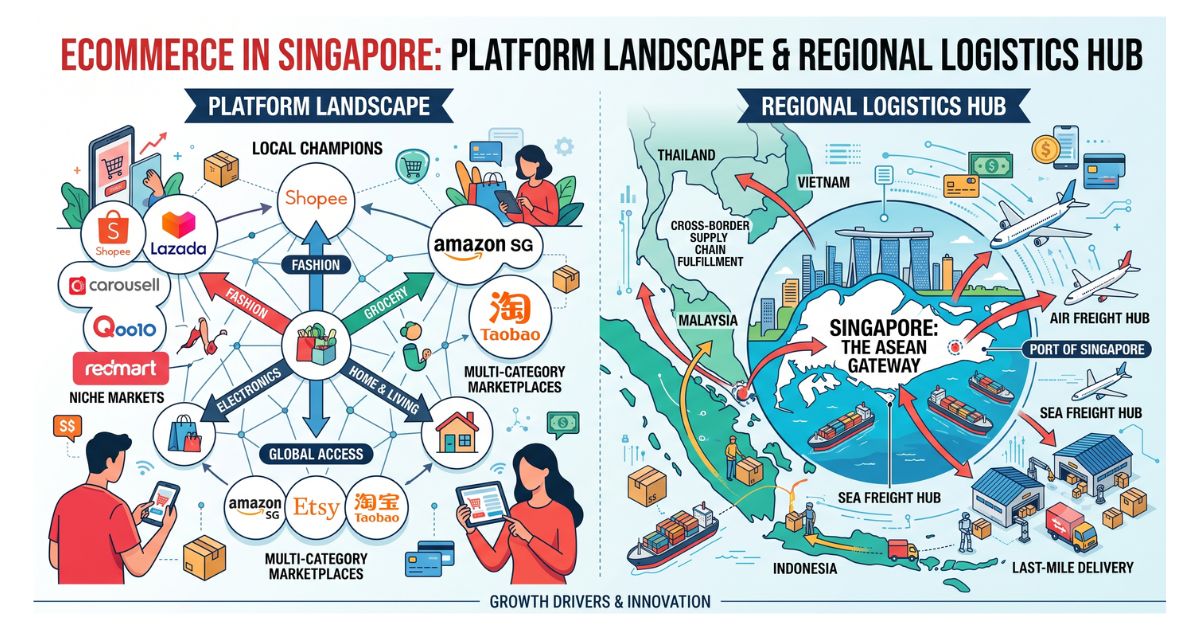
Table of Contents
Singapore occupies an unusual position in Southeast Asian ecommerce. As a market, it is compact — a city-state of roughly 5.5 million people — but punches far above its population weight in commercial value. Per-capita income is among the highest in Asia. Internet and smartphone penetration are effectively universal. Consumer expectations for delivery speed, product quality, and brand presentation match the highest standards globally.
As a logistics hub, Singapore is something different again: the region’s most efficient port and air freight gateway, a bonded warehousing centre, and the most practical first base for brands establishing a regional distribution footprint that extends into Malaysia, Indonesia, and beyond.
For brands entering Asian ecommerce, understanding these two roles simultaneously — Singapore as a target market in its own right, and Singapore as operational infrastructure for the region — is what allows them to make the investment serve both purposes rather than choosing between them.
This guide covers the Singapore ecommerce market from both angles: the consumer landscape and platform dynamics for brands selling in Singapore, and the logistical and operational case for brands using Singapore as a regional gateway.
Singapore’s Ecommerce Market at a Glance
Singapore is the most digitally mature ecommerce market in Southeast Asia — a compact, high-income city-state with near-universal internet penetration, strong consumer purchasing power, and delivery expectations that match global premium markets. For brands entering Asia, Singapore functions both as a direct revenue market and as the region’s most practical logistics and distribution hub.
The combination of high digital adoption, English-language fluency across the population, and well-developed payment infrastructure means that Singapore is as close to a frictionless ecommerce environment as exists in Southeast Asia. The challenges are different from those in larger regional markets — not technology access or payment infrastructure, but price point positioning, competitive density, and consumer sophistication.
Market Size and Consumer Behaviour
Singapore’s ecommerce market is smaller in absolute volume than Indonesia, Vietnam, or the Philippines, but generates disproportionately high revenue per transaction. Average order values are significantly higher than the Southeast Asian average across most product categories — a function of consumer income, brand preference for premium products, and lower price sensitivity relative to neighbouring markets.
Singapore consumers research purchases thoroughly before committing. Product reviews — both on-platform (Shopee, Lazada) and off-platform (Google searches, social media, community forums) — carry significant weight. Brands entering Singapore without a review accumulation strategy consistently underperform brands that prioritise review volume and quality from launch.
Trust signals matter more in Singapore than in most Southeast Asian markets. Shopee Mall or LazMall status, official brand store designation, and clear authenticity guarantees translate into conversion rate advantages that are measurable. In a market where a meaningful proportion of consumers are comfortable spending SGD 100 or more on a single ecommerce transaction, the credibility signals that tell buyers they are purchasing from an authorised source are commercial necessities, not optional brand investments.
The Singapore Platform Landscape
Shopee Singapore and Lazada Singapore
Shopee and Lazada are the dominant marketplace platforms in Singapore, as across most of Southeast Asia. However, the competitive dynamics within both platforms differ from larger markets. Seller density per category is higher relative to buyer volume than in Vietnam or Indonesia — meaning that search result pages in many categories are more competitive, and organic visibility requires both listing quality and advertising investment from an earlier stage.
Shopee Mall operates at a higher tier of brand credibility in Singapore than in some other markets, partly because Singapore consumers are more likely to specifically search for Mall-verified products in categories where authenticity concerns are present (health supplements, beauty products, electronics accessories). Achieving Mall status in Singapore should be treated as a near-term goal for any brand that qualifies, not a deferred aspiration.
The promotional calendar — Shopee 9.9, 10.10, 11.11, Lazada Birthday Sale and 12.12 — operates in Singapore with broadly the same structure as across the region, but with higher average transaction values during sale periods and stronger participation from international and premium brands.
D2C and the Role of Google Search
Singapore has the strongest D2C ecommerce environment in Southeast Asia. Google search-driven product discovery is more developed than in neighbouring markets — consumers regularly search for products, arrive at brand websites, and complete purchases without a marketplace intermediary. For brands with D2C ambitions in Asia, Singapore is the market where the D2C investment is most likely to deliver meaningful direct revenue alongside marketplace sales, rather than serving primarily as a data capture and brand presence channel.
This D2C viability makes Singapore a valuable testing ground for brands evaluating whether to invest in owned ecommerce channels before committing to the broader regional build. A D2C storefront that converts well in Singapore — where the consumer sophistication and digital environment are favourable — provides a realistic signal that the investment can succeed across the region with appropriate localisation.
Qoo10 and Category-Specific Platforms
Qoo10, while declining in relative market share, retains a loyal user base in Singapore, particularly in electronics and certain fashion categories. For brands in these categories, a Qoo10 presence may be worth maintaining even as Shopee and Lazada dominate overall traffic. Category-specific platforms — health and wellness marketplaces, local specialty retailers with online presence — can also deliver meaningful volume for brands whose product category aligns with their audience.
Singapore as a Regional Logistics Hub
The logistics case for Singapore is distinct from the market case, and for many brands it is the more strategically significant of the two.
Port and Air Freight Infrastructure
The Port of Singapore is consistently ranked among the world’s two or three busiest container ports by throughput volume. Its efficiency — in terms of vessel turnaround time, customs clearance speed, and onward distribution connectivity — is the highest in Southeast Asia and competitive globally. For brands shipping goods from manufacturing locations in China, India, or Europe into the region, Singapore is typically the most efficient primary receiving point.
Changi Airport, similarly, is one of Asia’s primary air cargo hubs — a critical capability for brands shipping higher-value or time-sensitive goods that require air freight rather than sea freight into the region.
This infrastructure concentration means that brands establishing regional distribution from Singapore begin with carrier relationships, customs clearance processes, and logistics partner ecosystems that are more developed than in any other Southeast Asian market.
Bonded Warehousing and Regional Distribution
Singapore’s bonded warehousing system allows brands to import goods into Singapore without paying import duties until those goods are sold and delivered locally, or re-exported to another market. For a regional hub-and-forward distribution model — where Singapore serves as the central inventory point and goods are shipped to customers in Malaysia, Indonesia, and other markets as orders arrive — this defers the duty cost and provides greater inventory positioning flexibility than most other regional hub options.
The practical implication: a brand holding inventory in a Singapore bonded warehouse can fulfil orders across Southeast Asia from a single inventory pool, paying duty only on units that are sold into the Singapore domestic market, while re-exporting units destined for other markets without triggering Singapore import duty.
How hub-and-forward distribution works across Southeast Asia →
Last-Mile Delivery Expectations in Singapore
Within Singapore’s domestic market, delivery standards are among the highest in Asia. Next-day delivery is the consumer baseline expectation for standard categories — same-day delivery is available from multiple carriers and is increasingly expected for premium product categories. Delivery to addresses within Singapore is reliable and efficient across all major carriers, with low exception rates compared to the regional average.
For brands new to Singapore, the operational implication is that delivery time commitments on marketplace listings need to be realistic and consistently met. Missing committed delivery windows damages seller ratings quickly in Singapore, where consumers are more likely to escalate late deliveries than in markets where delivery timeline expectations are lower.
How 3PL partnerships support last-mile delivery across Southeast Asia →
Regulatory and Compliance Considerations
Singapore’s regulatory environment is clear, consistently enforced, and relatively straightforward to navigate compared to most Southeast Asian markets — but it is not absent, and categories with specific regulatory requirements need those addressed before launch.
GST and Import Duties
Singapore charges Goods and Services Tax (GST) at 9% on most goods and services, including ecommerce purchases. Since January 2023, all goods imported into Singapore for sale — regardless of value — are subject to GST, removing the previous SGD 400 low-value import exemption. Overseas suppliers and platforms selling to Singapore consumers above a GST registration threshold are required to register for GST and account for it on their sales.
Import duties in Singapore are very low by regional standards — Singapore has extensive free trade agreements that reduce or eliminate duties on most goods imported from major trading partners. For most consumer product categories, the effective import duty cost is minimal or zero.
Regulated Product Categories
Certain product categories require additional compliance steps before sale in Singapore. Health supplements and nutraceuticals require notification to or pre-market approval from the Health Sciences Authority (HSA). Cosmetics and personal care products are subject to the ASEAN Cosmetic Directive, with specific prohibited ingredient lists and labelling requirements. Food products are regulated by the Singapore Food Agency (SFA). Electronics must comply with safety certifications applicable in Singapore.
Brands in these categories should verify compliance requirements specifically for the Singapore market before launch — the requirements differ from those in Malaysia, Vietnam, and Japan even within the same ASEAN regulatory framework.
What Singapore Consumers Actually Expect
Delivery and Fulfilment Standards
As already noted, next-day delivery is the baseline for most categories. Brands fulfilling from in-market warehousing in Singapore can reliably meet this standard through established local carriers. Brands fulfilling cross-border from a central hub — Malaysia, Thailand, or more distant markets — typically cannot meet Singapore consumers’ delivery expectations, which affects conversion rate and seller rating.
For any brand treating Singapore as a serious revenue market rather than a low-priority addition to the channel list, in-market inventory positioning is the operational prerequisite.
Trust, Brand Presentation, and Price Positioning
Singapore consumers are willing to pay a premium for quality — and they are sophisticated enough to distinguish between genuine quality and marketing presentation. Brands that enter Singapore with premium pricing but do not invest in the brand presentation, review accumulation, and customer service standards that justify premium pricing consistently find that the positioning does not hold.
Conversely, brands that compete on price in Singapore without a clear cost advantage over established local or regional competitors often find the market less hospitable than expected. Singapore is not a market where price leadership alone is a sustainable strategy — the consumer base is income-sufficient enough to pay for quality when quality is credibly demonstrated.
Singapore as a Testing Ground for Regional Expansion
The combination of a favourable operating environment, high consumer sophistication, and English-language market removes several variables that complicate reading performance in other Asian markets. A product listing created in English does not require localisation for Singapore; the logistics environment is predictable; customer feedback is articulate and specific.
For brands unsure whether to commit to the full regional build, a Singapore-first launch provides a high-quality signal about product-market fit, pricing architecture, and content effectiveness before the more operationally complex markets — Vietnam, Indonesia, the Philippines — are added.
The caveat: Singapore’s consumer profile, income level, and expectations differ enough from most of Southeast Asia that performance in Singapore does not perfectly predict performance across the region. A product that succeeds at SGD 80 in Singapore may need to be priced differently and positioned differently in Vietnam. Singapore validates the concept; regional expansion validates the localisation.
Building Your Singapore Ecommerce Operation
Whether Singapore is the primary target market or the first step in a broader regional build, the operational foundation is the same: in-market inventory positioning (or a logistics hub arrangement that can deliver domestically within next-day timelines), marketplace presence on Shopee and Lazada with Shopee Mall status pursued as a near-term priority, and a D2C channel if the brand intends to build owned customer data in Asia.
The agency requirements in Singapore differ from the rest of the region primarily in content — English-language content is sufficient for the Singapore consumer, without the translation and localisation overhead that Vietnam, Thailand, or Japan require. Marketing execution, however, still requires platform-specific expertise on Shopee Singapore’s algorithm and promotional mechanics, which differ in behaviour from Shopee’s other markets even though the platform is nominally the same.
What a full commerce enablement operation looks like across Southeast Asia →
Frequently Asked Questions
What are the biggest ecommerce platforms in Singapore?
Shopee and Lazada are the dominant platforms by traffic and transaction volume in Singapore. Both offer brand-tier seller accounts (Shopee Mall and LazMall) with higher credibility signals for verified brand owners. Qoo10 retains a loyal user base in electronics and selected fashion categories. D2C via brand-owned websites is more viable in Singapore than in most other Southeast Asian markets, supported by relatively strong Google search-driven discovery.
Is Singapore a good first market for brands entering Asian ecommerce?
Yes, for several reasons: the English-language environment removes localisation overhead, the regulatory environment is clear and consistently applied, the logistics infrastructure is the most efficient in Southeast Asia, and consumer sophistication provides high-quality product and content feedback. The caveat is that Singapore’s high income profile and consumer expectations differ meaningfully from larger markets like Vietnam and Indonesia, so Singapore performance should be read as concept validation rather than a precise predictor of regional performance.
How do import duties work for ecommerce in Singapore?
Singapore charges GST of 9% on imported goods sold to Singapore consumers, with no low-value import exemption since January 2023. Import duties are very low by regional standards — Singapore’s extensive free trade agreements reduce or eliminate duties on most consumer goods imported from major trading partners. Specific product categories (health products, cosmetics, food, electronics) are subject to additional regulatory compliance requirements before sale.
Can I use Singapore as a regional distribution hub for Southeast Asia?
Yes — Singapore’s port and air freight infrastructure, bonded warehousing system, and central ASEAN location make it well-suited as a regional hub. Brands using a hub-and-forward model can hold inventory in Singapore and fulfil domestically within Singapore and cross-border into Malaysia, Indonesia, and other markets as orders arrive. Bonded warehousing defers import duty on goods re-exported to other markets, improving the unit economics of regional hub distribution.
What delivery standards do Singapore consumers expect?
Next-day delivery is the baseline expectation for standard ecommerce categories in Singapore; same-day delivery is available and increasingly expected for premium categories and time-sensitive purchases. The domestic carrier infrastructure in Singapore is highly reliable by regional standards, with low exception and delay rates. Brands fulfilling from in-market Singapore inventory can consistently meet these standards; brands fulfilling cross-border from other markets typically cannot.
Ready to establish your Singapore ecommerce presence or regional hub?
Prime Commerce operates across Singapore, Vietnam, Malaysia, and Japan — providing marketplace management, technology infrastructure, and distribution capability integrated from the start, whether your goal is a Singapore-first launch or a full regional build from a Singapore base.
Talk to Prime Commerce about your Singapore ecommerce strategy →
Prime Commerce is a pan-Asian commerce enablement company providing Technology, Agency, and Distribution services across Vietnam, Malaysia, Singapore, and Japan.