
How to Choose a Digital Marketing Agency for Ecommerce in Asia (2026)
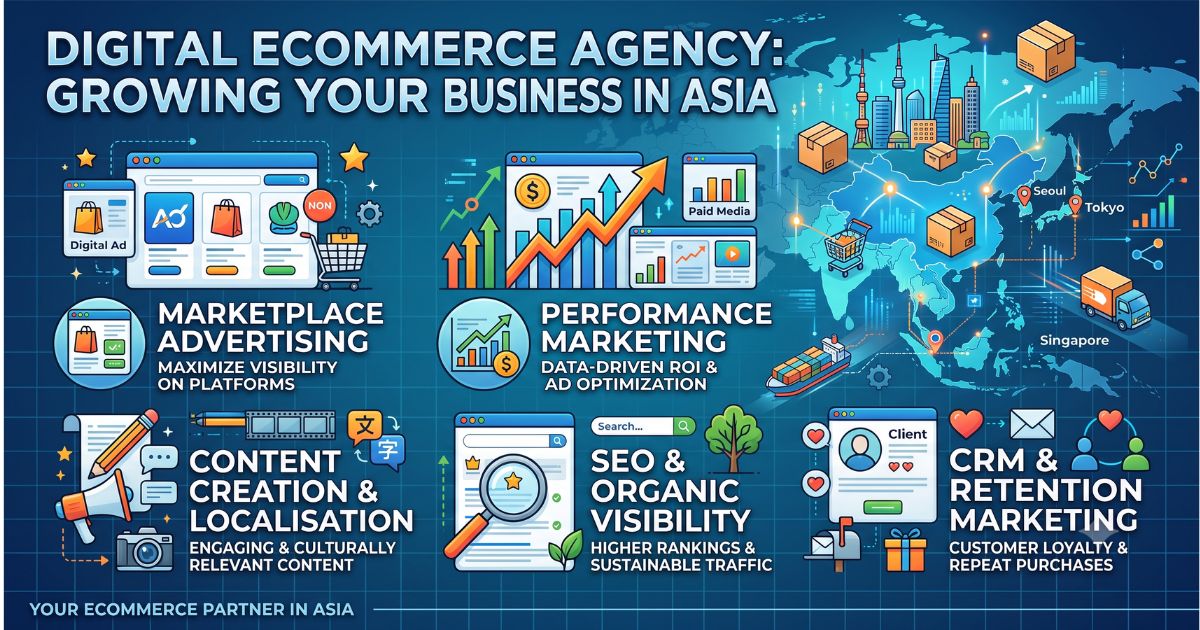
Table of Contents
The ecommerce marketing landscape in Southeast Asia has specific demands that most globally-focused digital agencies are not built to meet. Platform-native advertising on Shopee and Lazada, content localised for Vietnamese or Malaysian consumers, live commerce on TikTok Shop, and performance marketing calibrated to Southeast Asian cost-per-acquisition benchmarks — these are specialised capabilities that require regional depth, not digital marketing generalism.
A brand that brings a globally capable but regionally inexperienced agency into its Southeast Asian expansion typically discovers the gap quickly: ad spend that delivers impressions but not conversions, content that is technically correct but does not resonate, and campaign planning that misses the promotional windows that drive the majority of category volume in these markets.
This guide covers what a digital marketing agency for ecommerce in Asia actually does, what capabilities distinguish specialist regional agencies from generalists, how to evaluate potential partners rigorously, and what the right agency model looks like for different stages of Asian ecommerce maturity.
What Does a Digital Marketing Agency for Ecommerce Do?
A digital marketing agency for ecommerce plans and executes the marketing activities that drive traffic, conversion, and revenue for online sellers — covering marketplace advertising, paid social, content creation, SEO, and retention marketing. Unlike generalist agencies, ecommerce specialists are built around platform-specific expertise and performance metrics tied directly to sales outcomes.
The emphasis on sales outcomes rather than awareness or engagement metrics is what defines the ecommerce marketing discipline. Every channel, every campaign, and every piece of content is evaluated against its contribution to revenue — either directly (a Shopee Search Ad that converts to a purchase) or indirectly (a TikTok video that drives product awareness that converts on marketplace search two days later).
Specialist vs. Generalist: Why the Distinction Matters in Asia
A generalist digital marketing agency in Southeast Asia will typically be competent across Google Ads, Meta (Facebook and Instagram), and potentially LinkedIn — the global platform stack. An ecommerce specialist will have these capabilities and add: Shopee Ads and Lazada Sponsored Products management, TikTok Shop live commerce and content strategy, marketplace listing optimisation, promotional campaign planning around the regional sale calendar, and KOL (Key Opinion Leader) integration specific to each target market.
These are not minor additions to a generalist skill set. Shopee’s advertising system, Lazada’s promotional mechanics, and TikTok Shop’s content-commerce model are each distinct enough from global platform advertising that proficiency on one does not transfer to the others. A brand evaluating agencies for its Southeast Asian ecommerce operation should treat these as separate, evaluable capabilities — not assumed competencies.
The Core Services That Drive Ecommerce Revenue in Southeast Asia
The marketing services that move the needle for ecommerce brands in Asia differ in emphasis from what drives performance in Western markets. Understanding what to prioritise — and why — prevents budget allocation mistakes that are expensive to diagnose after the fact.
Marketplace Advertising
In Southeast Asia, Shopee and Lazada are where the majority of ecommerce purchasing happens. An agency that does not include marketplace-native advertising as a core capability is not a viable ecommerce marketing partner for this region, regardless of how strong its performance on global platforms may be.
Shopee Ads operates a cost-per-click Search Ads system (comparable in structure to Google Shopping, but with Shopee-specific quality scoring, bid logic, and keyword matching behaviour), Discovery Ads for browse-based placement, and promotional mechanics tied to Shopee’s campaign calendar. Lazada Sponsored Products, LazMall banner placements, and Lazada’s affiliate and brand partner programmes each require their own expertise.
The critical point: good marketplace advertising is not simply a media buying function. It requires real-time integration with inventory data (so ads are paused when stock runs low), pricing strategy alignment (so ad spend is not driving traffic to listings that are not price-competitive), and listing quality management (because ad placement efficiency is partially a function of listing quality, not just bid level).
Performance Marketing — Paid Social and Search
Meta advertising (Facebook and Instagram) and TikTok Ads are the primary paid social channels for ecommerce brand building in Southeast Asia. Google remains relevant for search-driven demand capture, particularly in Singapore and for brands in categories where search intent is well-developed (electronics, travel accessories, specialised health products).
What distinguishes ecommerce performance marketing from general brand advertising is the attribution model and the optimisation objective. Every campaign should be tied to a measurable ecommerce outcome — add-to-cart rate, purchase conversion rate, return on ad spend — and optimised against that outcome, not against reach, impressions, or engagement rate.
In Southeast Asia, the attribution challenge is significant. Consumers regularly discover products on one platform and purchase on another — a Meta ad that drives awareness which converts three days later on Shopee appears as organic traffic in Shopee’s reporting and as no-conversion in Meta’s. An agency without robust cross-channel attribution methodology will consistently misreport campaign performance and make suboptimal channel allocation decisions as a result.
Content Creation and Localisation
Content for Asian ecommerce is not content translated from English — it is content created for each market’s specific context, consumer preferences, and platform conventions.
A beauty product listing effective for Singapore consumers emphasises clinical evidence, certifications, and ingredient transparency. The same product for Vietnamese consumers benefits from social proof, KOL endorsement framing, and specific claims relevant to local skin concerns and beauty standards. Neither set of content is simply a translation of the other — they are different creative executions for different audiences, even when the product is identical.
Beyond marketplace listings, content scope for an ecommerce marketing agency includes: short-form video for TikTok and Instagram Reels (each platform has distinct formatting norms), product photography and lifestyle imagery calibrated to platform standards and local aesthetic preferences, and promotional creative assets for each major campaign period.
SEO and Organic Visibility
Search engine optimisation for ecommerce in Asia operates at two levels: website SEO (for brands investing in D2C channels, where organic search drives top-of-funnel traffic) and marketplace SEO (optimising listing visibility within Shopee and Lazada’s own search algorithms).
The mechanics differ significantly between the two. Website SEO for the Southeast Asian ecommerce audience requires content in English (for pan-Asian brands) and potentially local languages, with keyword strategy calibrated to the search behaviour of the specific target audience. Marketplace SEO is a function of listing quality, keyword placement in titles and attributes, seller rating, and engagement signals — with the added complexity that each platform’s algorithm weights these factors differently.
CRM and Retention Marketing
Acquiring a new customer in Southeast Asia’s competitive marketplace environment is significantly more expensive than retaining an existing one. Yet CRM and retention marketing is systematically underfunded in most brands’ marketing budgets relative to acquisition.
An ecommerce marketing agency with retention capability provides: post-purchase email and messaging flows (using platforms like Klaviyo for D2C customers, or in-app messaging for marketplace buyers where the platform allows), loyalty programme design and management, win-back campaigns for lapsed customers, and cross-sell and upsell strategies based on purchase history data.
The constraint in Southeast Asia is that marketplace platforms limit direct customer communication — Shopee and Lazada do not provide sellers with customer email addresses or direct contact information. Retention marketing for marketplace-heavy brands therefore concentrates on in-app follow-up (Shopee’s chat functionality, platform review requests) and on driving marketplace buyers to owned channels where direct communication becomes possible.
What Makes Ecommerce Marketing in Asia Different
Beyond the platform-specific capabilities already covered, four broader characteristics of Asian ecommerce marketing distinguish it from what works in Western markets.
Platform-Native Expertise Is Non-Negotiable
The platforms that dominate Southeast Asian ecommerce — Shopee, Lazada, TikTok Shop — have advertising systems, content formats, and algorithm logic that are distinct from anything in the global advertising landscape. An agency with deep Google and Meta expertise has transferable knowledge of paid media fundamentals — bidding, audience segmentation, creative testing — but not the platform-specific knowledge that determines performance in these environments.
Ask any prospective agency to show you campaign data from Shopee Ads accounts they are actively managing, and to walk you through a recent optimisation decision they made on the platform. The depth of answer reveals whether their Shopee capability is built from real operational experience or from general PPC principles applied without platform-specific calibration.
Content Localisation Is Not Translation
This distinction has already been made, but it warrants its own emphasis: the single most common content failure in Asian ecommerce marketing is mistaking translation for localisation.
Translation is converting words from one language to another. Localisation is adapting the full creative execution — messaging angle, visual style, claim selection, social proof format, and cultural references — to resonate authentically with the target audience in each market.
An agency claiming localisation capability should be able to demonstrate it with market-specific examples, not a description of their translation process.
The Promotional Calendar Demands Proactive Planning
Shopee’s and Lazada’s promotional calendars require campaign planning to begin weeks — sometimes months — before each event. The 11.11 campaign, for instance, requires stock to be confirmed and positioned in advance, creative assets produced across all required formats for all active platforms, advertising budgets pre-loaded, pricing decisions made with awareness of both competitive positioning and platform subsidy eligibility, and customer service capacity expanded for the anticipated volume.
An agency that approaches the promotional calendar reactively — producing campaign assets in the week before each event — is not delivering the preparation quality that these periods require. The brands that consistently outperform competitors during sale events do so because their planning and preparation process begins far earlier than competitors’ does.
Attribution Is More Complex — and More Consequential
The non-linear consumer journey in Southeast Asia — multi-platform discovery, cross-channel purchasing, mobile-first behaviour — creates attribution challenges that are more significant than in most Western markets.
Last-click attribution (which credits the final channel before purchase) systematically undercounts the role of upper-funnel channels — TikTok awareness content, Instagram brand advertising, search-driven product research — in driving purchases that ultimately happen on Shopee or Lazada. An agency optimising purely on last-click attribution will consistently under-invest in the channels that create demand and over-invest in the channels that capture it.
A competent ecommerce marketing agency applies multi-touch attribution methodology, cross-channel performance modelling, and incremental lift analysis — quantifying what each channel actually contributes to revenue rather than simply what shows up in last-click reports.
How to Evaluate a Digital Marketing Agency for Ecommerce in Asia
Choosing the wrong agency for Asian ecommerce is expensive to correct — not because exit costs are high, but because the opportunity cost of three to six months of underperformance is significant in a market where promotional calendar timing is critical. Evaluate rigorously before engaging.
Regional Market Coverage and Local Depth
An agency describing itself as a Southeast Asian ecommerce marketing agency may mean very different things in practice. Some have genuine in-country teams in multiple markets; others are managing from a central hub with freelance support for market-specific content. The distinction matters for localisation quality, platform relationship access, and the ability to respond to market-specific events quickly.
Ask specifically: which markets do you have in-country capability in? What does “in-country” mean — employees, contractors, or partners? In the markets I am targeting, who specifically would be working on my account and what is their market experience?
Platform Certifications and Partnerships
Shopee and Lazada both operate partner programmes for agencies managing significant advertiser spend on their platforms. Certified partners typically have earlier access to new ad formats, dedicated account management from the platform, and training on platform-specific best practices. These relationships are a meaningful proxy for genuine platform depth.
Ask whether the agency holds Shopee Partner or Lazada Partner status in your target markets, and what the basis of that certification is — account volume managed, examination-based certification, or some combination.
Category Experience and Verifiable Results
A beauty brand evaluating an ecommerce marketing agency should ask to see performance data from beauty accounts in Southeast Asia, not from adjacent categories or markets. An electronics brand should ask for electronics category experience specifically. The category-specific knowledge — which claim angles convert, which promotional mechanics drive the highest ROI in the category, which KOLs have genuine audience authority versus inflated reach metrics — takes time to accumulate and does not transfer readily between categories.
Ask for case studies with specific performance metrics: ROAS improvement, conversion rate uplift, cost-per-acquisition reduction. Ask whether those results were achieved for brands at a similar stage and scale to yours.
Integration with the Broader Ecommerce Operation
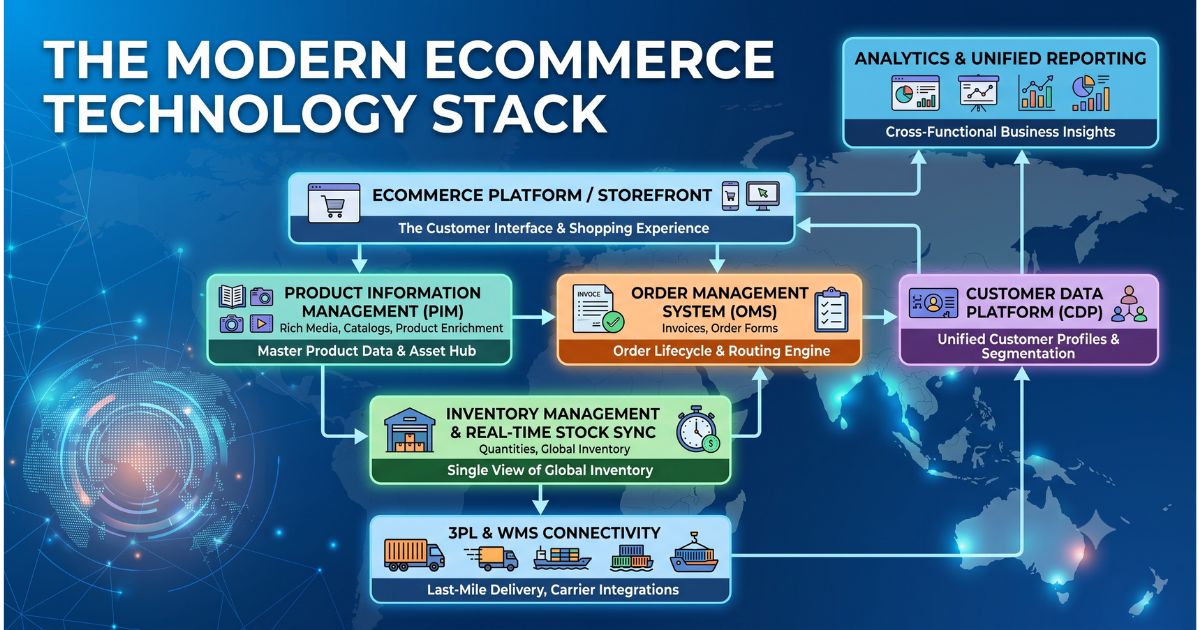
A digital marketing agency operates most effectively when it is connected to the rest of the brand’s ecommerce infrastructure — inventory and fulfilment data (so ad spend is not driving traffic to out-of-stock products), marketplace management (so promotional campaigns are coordinated with seller account mechanics), and technology (so campaign performance data flows into unified reporting alongside sales and fulfilment data).
An agency that treats its scope as isolated — delivering campaign performance without awareness of or connection to inventory, fulfilment, and marketplace account management — consistently creates coordination problems at the interfaces between its work and the rest of the operation.
Agency vs. In-House vs. Commerce Enablement: Which Model Fits?
Three structural approaches exist for managing ecommerce marketing in Asia, and the right one depends on the brand’s stage, budget, and operational complexity.
- In-house team. Provides the highest degree of brand knowledge integration and the fastest internal feedback loops. The constraint is resourcing: building genuine depth across marketplace advertising, paid social, content localisation, and SEO in multiple Southeast Asian markets requires a team size that most brands cannot justify until they have established significant regional revenue.
- Standalone agency. Provides specialist expertise without the fixed cost of building an internal team. Requires active management from the brand to ensure the agency is operating with sufficient context about inventory, product strategy, and commercial priorities. Works best when the brand has a strong internal marketing lead who can brief and manage the relationship.
- Commerce enablement partner. For brands that want marketing capability integrated with technology infrastructure and distribution operations — rather than managed as a separate vendor relationship — a commerce enablement partner provides agency services as one component of a coordinated regional operating model. This eliminates the coordination overhead between marketing, marketplace management, and logistics that standalone agency arrangements consistently create.
How marketplace management integrates with ecommerce marketing →
Frequently Asked Questions
What should I look for in a digital marketing agency for ecommerce in Southeast Asia?
Prioritise regional market depth over global platform credentials, marketplace-native advertising capability (Shopee Ads, Lazada Sponsored Products), verifiable performance results in your product category across your target markets, and a demonstrated understanding of how marketing integrates with inventory, fulfilment, and marketplace account management. Agencies that manage marketing in isolation from the broader ecommerce operation consistently create coordination problems that cost revenue.
How much does a digital marketing agency for ecommerce in Southeast Asia cost?
Pricing varies significantly by scope, markets covered, and agency tier. Entry-level managed service arrangements for a single market and one to two platforms typically start from USD 2,000 to 4,000 per month in retainer fees, with ad spend managed separately. Full-service multi-market arrangements covering marketplace advertising, paid social, content production, and SEO across two or more markets typically range from USD 8,000 to 20,000 per month in fees, plus ad spend. Commerce enablement arrangements that include marketing as part of a broader service bundle are typically structured differently.
Can one agency manage marketing across multiple Southeast Asian markets?
Yes, but not all agencies have genuine multi-market capability. An agency managing Vietnam, Malaysia, and Singapore simultaneously needs localisation capability in each market, understanding of each market’s platform dynamics and promotional calendar, and the operational bandwidth to execute across all three simultaneously without quality degrading on any individual market. Ask for specific examples of multi-market accounts the agency currently manages, and what their in-country resource model looks like per market.
What is the difference between marketplace advertising and performance marketing for ecommerce?
Marketplace advertising refers specifically to paid placement within marketplace platforms — Shopee Search Ads, Lazada Sponsored Products, TikTok Shop promotions — where the objective is visibility within the marketplace search results. Performance marketing is a broader term covering paid channels that drive traffic from outside the marketplace — Meta Ads, Google Ads, TikTok Ads as an awareness channel — to marketplace listings or D2C storefronts. Both are necessary for a mature ecommerce marketing strategy; they serve different stages of the customer journey and are managed through different platform interfaces.
How long does it take to see results from a new ecommerce marketing agency in Southeast Asia?
Marketplace advertising results are visible quickly — typically within two to four weeks of campaign launch, enough data exists to begin meaningful optimisation. Organic listing improvements from SEO optimisation take four to eight weeks to reflect in search rankings. Content localisation impact on conversion rate is typically visible within the first promotional cycle — the next major sale event after new content goes live. Brand-level initiatives — awareness campaigns, loyalty programme development — operate on longer time horizons and should be evaluated over three to six months rather than weeks.
Looking for a digital marketing partner for your ecommerce operation in Asia?
Prime Commerce’s Agency services combine marketplace management, performance marketing, and content localisation across Vietnam, Malaysia, Singapore, and Japan — integrated with technology infrastructure and distribution capability so marketing, operations, and logistics run as a coordinated system.
Prime Commerce is a pan-Asian commerce enablement company providing Technology, Agency, and Distribution services across Vietnam, Malaysia, Singapore, and Japan.